3.29.2021

Holy Week 2021

I didn't intentionally choose this week to begin my sabbatical. A collection of external factors coincided to make this the right time. I only realized this coincidence would be true a couple of days ago.

But it feels good. Around the world, this is a week of holidays for Christians. In some contexts, secular holidays - schools and businesses are closed. In other contexts, the procession from Palm Sunday to Easter Sunday, with special rituals of remembrance on each day in between.
• • •
Holy Monday was the overturning of the tables in the temple. A challenge to unjust economic systems. For me, this time of rest and creative activity feels like a direct challenge to the economic structures of our day. For me, this ten week period feels like a sabbath season. A time to make right the patterns of my life. 8 hours for work, 8 hours for rest, 8 hours for what we will.

What do I will? And perhaps, not what I will, but what God wills. Not God's agents on Earth, not the church, not the government, but the Holy Creator, Source of All Wisdom, Beauty, Goodness. Not Caesar.

My main plan for this week is to begin by writing every day. To go swimming several days. And to schedule all the appointments that I put off until now. A haircut, a mammogram, new glasses, and more. It may take my whole sabbatical season to get to them all.

I already scheduled two - a deep cleaning for our house and our car. These fall into the category of things I could do for myself. However other people will be more efficient and right now I would rather pay someone to do it well and get it over with and not be exhausted when it is done. It will free me to think about other things instead of fretting about the housework. This goes against all my home training, but for once, I think it will be a good tradeoff.
• • •
Later in the week, Maundy Thursday is a reminder about community and service to others. Will I find ways, during this sabbatical season that overlaps with the Covid19 pandemic, to break bread with others and wash their feet? As a serious extrovert, I need to talk to other people for my own mental health. And as a human being and a Christian, I need to be of service to other people. Also for my own mental health. But I also need to practice some discipline around "custody of the eyes". The main purpose of this break is to bring forth that which is in me - to give to the world that which only I can give. Not to spend the time reading what other people have already written.

But recognizing the enormous privilege of having ten weeks in a row of paid leave, without even a newborn baby to take care of, I want to find some way to be of practical service to the community around me in this time as well.
• • •
Holy Friday and Saturday are about dying to self and waiting in the deep unknown. Am I able to give over my own longing to know or do or be anything and sink down to that seed that God sows in the heart? And to let that seed grow in me and breathe in me and be in me without striving to make myself more? For that seed to increase, I must decrease. In my striving and my desire for control and for fame and fortune and, and, and... everything. Not my will, Lord, but thine.

• • •
Then next Sunday, I will be going away. To an undisclosed location. For a week of self-denial of other people and the freedom to just write. A rebirth in some ways, maybe more like extended labor. I don't think it tracks to a resurrection. I'm afraid it's going to feel more like an extended Holy Saturday.

But we'll see. What freedom comes in that emptiness? What new inspirati­on or motivation? What will I be able to produce under those conditions? I have no idea.

Seventeen years ago, I went away for a solo retreat for a weekend. At that point in my life, what I most needed was for no one to touch me for 48 hours. I literally had to wean the baby in order to go away. The writing was just a serendipitous byproduct. But my life has changed ever since. And that baby is 19 years old now.

One of the things people keep telling me is not to have too high of expectations for myself in this sabbatical season. To not feel like I have to fill it with any particular kind of productivity or to set too concrete of a goal. That has been helpful advice.

But I am trying to establish the conditions for creative output to be possible.

I am trying to leave margins of time and energy to do what feels right in the moment.

To seek God's guidance in each day, each moment. And then to follow that guidance wherever or however it may lead.

• • •
This is the way.

That would be enough.

Amen.

Labels: , , , , , , ,

Subscribe to Post Comments [Atom]

8.04.2020

Un Salmo de Robin, 25 julio 2020

"Un Salmo de Robin" fue escrito el 25 julio 2020 como un ejercicio durante un retiro contemplativo de escribir nuestro propio salmo, utilizando nuestras oraciones sencillas, oraciones de nuestro corazón. La traducción en ingles esta abajo.

Querido Dios,

Ayúdame a que los dichos de mi boca y la meditación de mi corazón sean los mismos.

Reconozco que en tu creación somos tan minúscula como una montaña y tan magnifico como una brizna de hierba.

Pero en nuestra tierra, el mundo llora.

La justicia atrasada es justicia negada. Aun la pandemia no puede detener el progreso de la justicia. Pero ruego su misericordia con los que estamos vigilando nuestros muertos a solas. La raza humana no fue creada para la vida solitaria, sino una vida solidaria.

AMOR, me has creado para esto? ¿Para un tiempo así? Ayúdame a escuchar el susurro de tu voz y que la dejo guiar mi voluntad y mis pasos.

Mi pueblo adoptivo son los Cuáqueros. Con sus antecedentes heróicos y pecaminosos. No puedo asumir el uno sin el otro. Y me has llamado a servir a través de ellos. ¿Quieres que siga haciendo lo mismo? ¿Que estoy apoyando a los Cuáqueros a conocerse unos a otros? Que estoy creando espacio para los demás líderes a tomar sus puestos? ¿Vale la pena trabajar en la viña del Señor en una época así? En vez de la política de mi país?

Me contestas que sí. Para sostener a los que van a cambiar el mundo. Al socorro de tus labradores. Obedezco.

Ayúdame a construir con mis esfuerzos y nuestros Amigos una rampa de acceso para los que han escuchado tu voz y quieren hacer mejor pero que no saben como empezar ni para cual puerta entrar ni salir.

Ayúdame a recordar que no soy separada de ellos, ni los heridos ni los que hieren a su prójimo.

Ayúdame a crear un espacio para hablar de los verdaderos anhelos de nuestros corazones. Ayúdame a escuchar más que hablar. Que no dejo pasar la oportunidad de hacer lo necesario. De hacer lo justo. AMOR, hasta cuándo?

Aunque sigo agradecida por lo que me has brindado.

Ayúdame a no dejar de ser la mujer de mi marido, la madre de mis hijos, la dueña de mi casa, vestida de sencillez y justicia, mujer hacendosa. Reconozco la enseñanza de mis padres para cuidar de mi casa y enseñar a mis hijos. Agradezco la enseñanza de la universidad que no me libra de limpiar mi propia cocina pero no tengo que limpiar las cocinas de otras. Agradezco que me has proveído un hombre hecho y derecho, mi ayuda idónea, quien merece mi confianza y apoya a mi ministerio. Quien se acerca a mi con cariño y me hace reir. Señor del AMOR, ayuda a tod@s a encontrar la ayuda idónea para ell@s. Ayúdame a no despreciar el ministerio en mi junta local a favor de cualquier ministerio global o de aclamación mundana para no olvidar lo tedioso y lo precioso que es la comunidad cotidiana, que es la placa petri de la vida espiritual.

Ayúdame a hacer lo que está en mis manos por el bien de los días que me han tocado vivir, extirpando el mal en los campos y las calles que conozco, y dejando a los que vendrán después una tierra limpia para la labranza.

Y siempre, que no sea como yo quiero, AMOR, sino como tú quieras.


This was written as part of a contemplative retreat exercise to write our own psalm, using our own simple prayers of the heart.. Here is the translation:

A Psalm of Robin, July 25, 2020

Dear God,

May the words of my mouth and the meditations of my heart be the same.

I know that in your creation, we are as miniscule as mountains and as magnificent as a blade of grass.

But in our land, the world cries out.

Justice delayed is justice denied. Even the pandemic cannot stop the progress of justice. But I ask your mercy upon those of us who are mourning alone. The human race was not created for a solitary life, but for solidarity.

LOVE, is this what I was made for? For a time such as this? Help me to hear the whisper of your voice and to let that guide my will and my steps.

You know the Quakers are my adopted people, with both their heroic and their sinful past. I cannot take on one without the other. And you have called me to serve through them. Do you really want me to keep doing the same thing? Supporting Quakers to get to know each other? Creating spaces for other leaders to take their places? Is it really worth laboring in the vineyard of the Lord at a time like this? Instead of the politics of my country?

I hear the answer is yes. I am called to support those who are going to change the world. To succour your laborers. Got it.

Help me to build, with my own efforts and these our Friends, an access ramp for those who have heard your voice and want to do better but who do not know how to start or which door to come in or go out. Help me to remember that I am not separate from the others, neither the wounded nor those who wound their neighbor.

Help me create spaces where we can talk about real things, the true longings of our hearts. Help me to listen more than I talk. May I not miss any opportunity to do what is necessary. To do what is right. LOVE, how long?

Still, I’m grateful for all I have received.

LOVE, may I not fail to be the wife of my husband, the mother of my children, the mistress of my house, dressed in simplicity and righteousness, known as a capable woman. I will remember the lessons from my parents so I can care for my home and teach my children. I will appreciate the university education that doesn't stop me from cleaning my own kitchen but spares me from cleaning other people’s kitchens. I am grateful that you have provided me with a man of integrity, a worthy helpmeet, who merits my trust and supports my ministry, who cares for me with gentleness and makes me laugh. LOVE, may everyone find the worthy and willing helpmeet that is right for them. Help me not to forgo ministry in my local meeting in favor of any global ministry or worldly acclaim so as not to forget how tedious and how precious is our everyday community, which is the petri dish of the spiritual life.

Help me to do what is in me for the succour of those years wherein I am set, uprooting the evil in the fields and the streets that I know, so that those who live after may have clean earth to till.

And always, not my will, LOVE, but yours.

Labels: , , , ,

Subscribe to Post Comments [Atom]

1.26.2014

Why I Really Went to Bible Study This Morning

One time a journalist supposedly asked a bishop, “Do you really believe that prayer changes things?” And the bishop answered, “Well, when I pray, coincidences happen, and when I don't, they don't.”

The painter Picasso supposedly said, “Inspiration comes, but it has to find you working.”

This is a long story.

I went to Bible study at my new meeting for the first time today. That’s two and a half years since I started coming here, for those who are keeping track at home. Over the last 15 years or so, when I might have been interested in going to Bible study, mostly I have said to my husband, “That’s okay, dear, you go. I’ll stay home and bring the children to meeting for worship later.” And really, it was fine. But now I realize we are in a new phase of life – our children could walk themselves to Meeting without us if they had to, and I can go to Bible study if I want to.

So yesterday, Chris and I went to a daylong conference organized by our new yearly meeting for Friends interested in Ministry and Worship. Really, we went as a favor to the organizer. We stepped in at the last minute to lead an afternoon workshop on adult religious education. (We showed a Nooma film with Rob Bell, among other things!) But in the morning, we were talking to another Friend from our new meeting about the Bible study he was planning to lead today and the blueberry coffee cake he was planning to make, and I said, hmm, maybe I should go.

Last night Chris and I talked about the logistics, and it turned out that the boys were willing to go early if they could get a ride and have some blueberry coffee cake, so we decided to all go. Then just before bed, Chris informed me that the group was reading the Gospel of Thomas, and I was skeptical. I haven’t studied the ordinary Bible enough, do I want to start on the Gnostic Gospels too? I decided I was just really tired, and that I ought to go, because it’s my meeting community not because of whichever book they’re reading. So I said, well, I’m not setting my alarm. If I wake up in time to go, that’s great, but if not, I’m going to sleep as long as I need to.

But lo and behold, I was wide awake and ready to leave by 9:30 am. We got to the meetinghouse, got some coffee and a choice between banana-nut or blueberry-orange breads. Yum. Then I had to ask Chris, so where does this group actually meet? He pointed to the room under the stairs at the back of the kitchen. There were five of us for Bible study today, and the reading was interesting and the worship-sharing was interesting, but I think now that’s not really why I was meant to go today.

I had never fully been in that room before. I didn’t know there was a lending library in there. I had only seen the historical books in the library room upstairs. There were a lot of good books in the collection. On the shelves across the room from where I was sitting, I saw a book I’ve been wanting to read for a couple of years now, called Sustaining Our Spirits: Women Leaders Thriving for Today and Tomorrow. It was recommended to me by Mary Ellen McNish, one of the authors. So that was cool.  And when I walked over to look more closely, I found another book that I really need to read right now, called Leading from Within: Poetry that Sustains the Courage to Lead from the Center for Courage and Renewal (Parker Palmer’s outfit). Here’s a poem that I really needed this week:
"Sabbaths"
Whatever is foreseen in joy
Must be lived out from day to day.
Vision held open in the dark
By our ten thousand days of work.
Harvest will fill the barn; for that
The hand must ache, the face must sweat.

And yet no leaf or grain is filled
By work of ours; the field is tilled
And left to grace. That we may reap
Great work is done while we’re asleep.

When we work well, a Sabbath mood
Rests on our day, and finds it good.

--Wendell Berry
But the real reason I went to Bible study this morning is because I have to show up for the things that are happening at my meeting. I have to say yes to the long form improv scene that is the life of my spiritual community. Worship this morning was so full for me. Full of new insights and old lessons and bubbling over with ideas. I needed that. I needed Bible study this morning. I needed the workshop yesterday afternoon. I need the community that gathered there, and here. I need to say yes to the leadings of the Holy Spirit, not just no to all the things that feel like distractions from my job and my family life.

Thy will, Lord, not mine.

Labels: , , , , , , , , ,

Subscribe to Post Comments [Atom]

9.03.2013

What We Talk About When We Talk About Rob Bell

I don't know Rob Bell. But I'd like to thank him for his work. Thank you for writing books that I like to read. But thank you even more for writing books that my 15 year old son likes to read and that we can talk about afterwards.

I first heard about Rob Bell in 2006 when he appeared in a series of Nooma films. I arranged to show a series of these short, postmodern films about God at San Francisco Friends Meeting after reading about how Gregg Koskela had shown one at Newberg Friends Church.

Velvet ElvisThe first one of his books that I read was Velvet Elvis: Repainting the Christian Faith. It's a reminder of all the different ways people have been Christians and how there can be more than one way to follow Jesus just like there is more than one way to paint a picture of Elvis. (Just re-reading pieces of it while writing this blogpost was inspiring all over again.)

Our copy of SexGod: Exploring the Endless Connections between Sexuality and Spirituality has about the most boring cover you could imagine. But it is a beautiful work of thinking and writing on the inside. I hope my sons will read this one too. (For those of you who worry about these things coming from an Evangelical Christian, as far as I can remember, it doesn't talk about same gender relationships. Neither condemning nor affirming. It is clearly heteronormative but fairly progressive about male-female roles in heterosexual relationships. If you can translate from that to your own situation, you might like it.)

Drops Like Stars HardcoverSomebody gave us a copy of Drops Like Stars, about creativity and suffering. It's beautiful, but I didn't really get it. But eventually, I figured out that it wasn't written for me. Me who likes to read all the words, the writer, the know-it-all, the girl-who-always-raises-her-hand-in-class. It is designed for people who think like visual artists. You know who you are.
What We Talk About When We Talk About God
All of this came up because Chris brought home Bell's latest book, What We Talk About When We Talk About God. Chris read it, then I read it, then our 15 year old son read it while in meeting for worship the other week. [For more on teens reading in worship: part 1 and part 2] Bell asks why we still talk about God and how we have to be/get to be open to new ways of talking about God and deal with the both/and nature of much of the discussion. Then Bell explains that he thinks that God is with us, for us and ahead of us, and then why this all matters in this day and age. Right on, brother.

I don't actually agree with everything that Bell writes, but pretty close. And I find his books to be a very engaging and inspiring conversation partner and conversation starter. I asked my son if he thought other young Friends would be interested in reading and discussing it and his eyes got big and he said Yes. So let me encourage other Friends to bring this to the attention of any youth group or any mid-week study group - it's a fine way to get into the discussion about what we actually know or believe about God.

Love Wins HardcoverAs usual, my timing is off regarding big moments in the blogosphere. I finally read Bell's 2011 book
Love Wins: A Book about Heaven, Hell, and the Fate of Every Person Who Ever Lived. This caused a huge controversy a couple of years ago in Evangelical circles but I didn't actually read it until I checked it out of the library last week. (I was a little busy in 2011, and did not have the bandwidth to argue much about theology just then.) It has a lot in common with If Grace is True and If God is Love by Phil Gulley and Jim Mulholland. Bell just issued a new version, Love Wins for Teens which I don't quite understand because I think the original is pretty accessible for teens, but maybe the new pink cover will appeal to a different demographic?

So the last thing I want to write about is the rockstar pastor phenomenon. Rob Bell has been one of the biggest of this millenium. Best selling author, 10,000 member church at some point, one of Time's 100 most influential people in 2011, New Yorker profile in 2012. But he left that to move to California, write, surf and maybe make a tv show. I have to hope that he now has more time for his family.

I am grateful that Bell writes about his doubts about being a pastor, a Christian, a worthy human being. And I am happy for him that he was able to take a break, to step away from the push to do more, bigger, faster.

But I wonder about the rockstar Quakers I have known, who have charisma and depth, who aren't actually rockstar famous. Is that a good thing? Or not? This topic is probably another blogpost in itself, but I will just put it out there for you to think about.

Labels: , , , , , ,

Subscribe to Post Comments [Atom]

1.28.2013

Dirt and the Good Life

Dirt and the Good Life: Stories from Fern Creek
by Lisa Graham McMinn and Mark R. McMinn 
Published in 2012 by Barclay Press,
cover design by Darryl Brown 

This is a collection of short essays about the life of two college professors who decide to start a farm on five acres of land in western Oregon and to start selling their produce through a CSA (Community Supported Agriculture) where people pay an annual price to receive a weekly share of the crops. Some of the stories are about their spiritual journeys, some are about their marriage and family, some are about sustainable living, and some are about their farm.

Things I liked about this book:

1. The cover. I don’t think I ever mentioned the name of the designer in a book review before. But I noticed I liked this one right away, especially compared to a lot of small press book covers, and then I recognized the name. I like a lot of his work, which can be seen on his blog.

2. Their obvious but not blind or cloying love for each other, and their ability to write about it with grace. Two people who have been married for many years, who are honest about the hardships, grateful for the blessings, and are still crazy about each other. Gives me hope, it does.

3. Their humor and willingness to laugh at themselves and each other. This is probably a strong contributor to #2. And it makes the book fun to read.

4. The stories about farming: plants, animals, tools and weather. I am not a farmer, and I never want to work that hard. But I am related to some farmers (some long gone) and I love these stories about the real things in life.

5. The way that their Christian values inform their relationships and their stories without overwhelming everything else. This is hard to do in writing.

6. They’re Quakers and I know their pastor. I always like the feeling that even if I don’t know the author personally, that there’s a chance that I could meet them and that we’re not really that different. And I like it when people make Quakers look good in public.

Things I didn’t like (which are all somewhat ironic):

1. I am not cooking enough to make it worthwhile to join a CSA and this book made me feel sorry for myself.

2. It occasionally comes close to being too sweet – it worked for me, but a snarkier reader might take it badly.

3. I didn’t get to meet Mark and Lisa yet. (One more reason to visit Newberg again. See #6 above.)

One of the chapters/stories is called Downward Mobility. In it, Mark tells about writing a book that flopped and how that financial failure was a nudge towards living a better life. He says that he then gave up on ever writing a best seller. I hope that Dirt and the Good Life proves him wrong. It's that good.

Full disclosure: I received a free copy of this book from the publisher. He didn’t ask me to write anything about it, and I wouldn’t have if I didn’t really like it, but just so you know.

Labels: , , , ,

Subscribe to Post Comments [Atom]

1.24.2013

The Tools We Need

It is not a new statement that among Friends, we are all ministers. We have different gifts and experiences, but we all have some. And we can all use some basic tools in our ministry. But we don’t all get the basic training that would help us to live up to our potential as ministers. Last weekend, I attended a basic training workshop, called “The Nursery of Truth.”1

Adam Sweeney and three other musicians
The event began with a large gathering of Friends from about a 50 mile radius for great music by Adam Sweeney and friends and an introductory message from Zachary Moon.

Zach Moon at the podium
Zach's message was about the importance of loving our enemies and learning to understand the people we think of as our enemies. His own spiritual journey has taken him from counter-recruitment community organizing to ministering to a Reserve Unit of the U.S. Marine Corps as their Chaplain. I can not say that I understand his leading, but I do believe that
  1. God works in mysterious ways 
  2. Jesus’s commandment to love our enemies is both clear and hard 
So we all need all the encouragement and inspiration we can get, and Zach brought both in abundance.

On Saturday, three Friends taught specific skills applicable to any Friend. The group that was invited to attend the full day session were intentionally a younger and more economically diverse crowd.2  Let’s be clear, in this group, I was old, and maybe ¼ of the people were older than me. I was invited to attend as an elder, not in the chronological sense, but as a grounding and experienced presence and resource person. I will admit that I currently fit none of the requested categories (see note 2 below), but I’m glad I was there, nonetheless. My favorite description of my role (I didn’t make this up): to serve as “an agent of contagion for the Holy Spirit.” I pray that I may have served that role in ways I don’t even know.

Kathy Hyzy at the podium
So the first session was on Spiritual Storytelling with Kathy Hyzy. She encouraged us all to see ourselves as storytellers. She reminded us that a wide swath of the stories we tell about our lives are spiritual and exhorted us to use our stories in our vocal ministry. Then she told a powerful story from her own life, of coming to Friends as a teenager after her mother’s death. And then she divided us into small groups to practice telling our own stories. Of course there wasn’t really enough time, but in my small group, the stories were profound, personal, brave and short.

The second session was on Quaker Remix with Wess Daniels. It was a better developed version of a bit he did at Quaker Heritage Day in 2011.  I think this is a key element of his doctoral research and I look forward to reading his final version. Essentially he gave us a framework for how to become effective ministers. We have to steep ourselves in our tradition, learn it deeply as apprentices, and then remix it with our contemporary (postmodern) culture in order to have it be accessible and relevant and then test that in a participatory community. Wess did a great job of posing questions and drawing the answers out of the group. How did we see this as true or not, how did it apply to our own lives and our Quaker Communities? 

Wess Daniels and the diagram of his framework
My personal question is do we have/are we creating enough apprentices in our tradition to have a sustainable chance for our religion? And if not, is there anything we (meaning I) can do about it? Again there wasn’t enough time (like a whole week) to get into it really deeply, but it was an introduction and food for much thought and conversations that could continue for years.

One advantage of having a lot of local folks coming together is that many of them will see each other again. A further advantage was how many different churches and meetings were represented so the conversation can be replicated in many places.

In the middle we all went out for lunch, most of us to Burgerville in Camas. This was a chance for me to get to know some of the other young-ish women at the event, particularly three I had met before, but never really talked to. The four of us were not only from three different churches, but three different yearly meetings, and the discussion exposed shared values and concerns that were both fun and heartening to discover.
Peggy Senger Parsons with a BIG bible
That's a big Bible.

The third session was about using the Bible as a bridge, not a battering ram, with Peggy Senger Parsons. She reviewed many of the ways people use the Bible and encouraged us to take the time to figure out how to articulate how we use the Bible (or would like to). And then she encouraged us to practice telling the story of a positive experience we have had with the Bible that we can launch into at any moment, in any company, if only as a non sequitur kind of jujitsu move to shift a discussion and to diffuse the tension when necessary. Her third practical tip was to choose a favorite verse or commandment and to deflect attempts to draw you into unproductive arguments by focusing on your chosen verse. As in “I know you want me to get wound up about _________, but you know, I’m still working on how Jesus said ‘Love your enemies,’ and it’s taking all I’ve got for now. When I get that down, then I will work on your suggestion.” These all seemed very useful for staying in relationship with people who have different uses for the Bible without compromising your integrity or getting caught up in arguments with a lot of heat but not much Light.

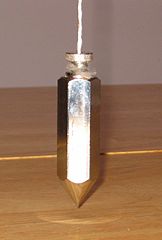
Plumb bob
Plumb bob from Wikipedia Commons
 The last part was Sunday morning worship at Camas Friends Church (a Quaker Meeting).  Peggy brought the message and a plumb bob.  Have you seen one before? It’s a heavy weight on the end of a string that helps to determine the vertical straight line that carpenters use to determine if a building is going up straight. It works because the weight always points to the center of the earth. She compared it to the Love of God, which can help us to orient our lives. The message was also about Truth and Compassion. And I didn’t take very good notes because it was an awe-inspiring message that captured my full attention. When I grow up, I want to know how to preach like Peggy. The Lord knows I will never be that good, but I am taking lessons starting now.

So now what? I know that the ministers who pulled this together are hoping that this Nursery of Truth idea might catch on. And if it did, I think that would be a good thing for the Religious Society of Friends/Friends Church. But how? Would it work to transport these ministers out of their local environment and invite them to speak at your meeting? Yes. Individually or as a group? Yes. Would it help to be conscious of how they went about attracting a not-the-usual-suspects crowd? Yes. Would it work to invite the ministers who are already in your local area to share their practical skills with Friends near you? Yes.

Would it be the same? No. I think that is the catch. God works in those mysterious ways, remember? Trying to replicate specific events or constellations of events becomes discouraging. We need to be open to how the Holy Spirit is leading us every time, all the time, and that is hard.

I think this is the lesson of Quaker open worship – it is different every time, but we need to keep coming back and experiencing the opportunity, even through dry spells, even when you know that people are going to talk about the latest political crisis (in our yearly meetings or in Congress), because we don’t know how or when the Holy Spirit will reach in and grab us by the scruff of the neck and take us to a new place.

Are you ready for that trip over Jordan? I don’t mean dying, I mean going to a strange land where we will have new responsibilities and new opportunities. This “new” land may look surprisingly like the neighborhood where you’ve been living all this time, or it may be thousands of miles away, but it will require new strength and courage to live there. And the basic skills of storytelling and relationship-building and a framework for understanding our place in the Divine story.

For these, I am grateful to the Nursery of Truth, and to Wess, Kathy, and Peggy for having the vision and the courage to bring us together.


All photos from Wess Daniels' Flickr set for Nursery of Truth unless otherwise noted. If you’d like to read more of the real-time commentary, search the Twitter stream for #nurserytruth.

1. Nursery of Truth was one of the names for the island of Barbados where many Quakers coming to the Americas in the 1600s stopped for rest and instruction before arriving in the northern English colonies. To read more, visit  Wess's blogpost.

2. Here is the list of attributes that were sought: Under 30 – AA – NA – LGBTQ – military service – never attended a cross-Quaker event – Work an hourly wage job – attend a Spanish language Friends Church – Rent your home – New Quaker – HS diploma or Associates degree as highest degree – Single parent – have ink or a bike that drinks fossil fuels…

Labels: , , , ,

Subscribe to Post Comments [Atom]

7.15.2012

You Can't Have It All

Psalm 90
Lord, thou hast been our dwelling place in all generations.
Before the mountains were brought forth, or ever thou hadst formed the earth and the world, even from everlasting to everlasting, thou art God.
Thou turnest man to destruction; and sayest, Return, ye children of men.
For a thousand years in thy sight are but as yesterday when it is past, and as a watch in the night.
Thou carriest them away as with a flood; they are as a sleep: in the morning they are like grass which groweth up.
In the morning it flourisheth, and groweth up; in the evening it is cut down, and withereth.
For we are consumed by thine anger, and by thy wrath are we troubled.
Thou hast set our iniquities before thee, our secret sins in the light of thy countenance.
For all our days are passed away in thy wrath: we spend our years as a tale that is told.
The days of our years are threescore years and ten; and if by reason of strength they be fourscore years, yet is their strength labour and sorrow; for it is soon cut off, and we fly away.
Who knoweth the power of thine anger? even according to thy fear, so is thy wrath.
So teach us to number our days, that we may apply our hearts unto wisdom.
Return, O LORD, how long? and let it repent thee concerning thy servants.
O satisfy us early with thy mercy; that we may rejoice and be glad all our days. Make us glad according to the days wherein thou hast afflicted us, and the years wherein we have seen evil.
Let thy work appear unto thy servants, and thy glory unto their children.
And let the beauty of the LORD our God be upon us: and establish thou the work of our hands upon us; yea, the work of our hands establish thou it.
There are only 24 hours in each day and we don’t know how many of those we’re going to get.

I’ve been thinking a lot lately about the choices we make in life. Particularly because of reading Ann Marie Slaughter’s article in The Atlantic magazine, “Why Women Still Can’t Have It All.” She wrote about how she had to choose between a very high level government job and being a good mother because of the insane hours required by her workplace. Positions of power come with a price to pay in terms of everything else in your life.

And then Tony Jones just wrote a brief blogpost about how he realized that he can’t read everything he thinks he ought to and also write everything he thinks he ought to. In fact, I think he probably could, but then he couldn’t also be a little league coach or a police chaplain or a decent father and husband, all of which he has done at some point. The ivory tower also has a price.

There are only 24 hours in each day and we don’t know how many of those we’re going to get. In my own life, I’m praying a lot lately about how to discern God’s calling in my life. Would it be better to dedicate myself to one thing, to the exclusion of all others? Is it better to balance two or three? Would it be better to do a little bit of many?

I think my husband is afraid when I talk about this that I’m going to leave him and the boys to follow God. I’m not. I’m just grateful that when Jesus said to me, drop your nets and follow me, that my husband and sons were willing to come to Philadelphia too.

I don’t think I’m designed for a single focus. I don’t think it’s quite Attention Deficit Disorder but I am interested in too many different things to be able to do just one. I think my variety of experiences has made me a better servant for God’s work. A better employee and supervisor in my office. A more interesting human being.

On the other hand, I really want to do well at my new job. I understand I have been given a great responsibility. I want to live up to my own and other people’s hopes and expectations. This morning, when I spoke about this in meeting for worship, someone else rose and said we don’t all have to aspire to greatness, or to be world leaders, it’s enough for the words of our mouths and the meditations of our hearts to be merely acceptable. Which is true. But some of us do aspire to more.

Like everyone else, I have to make choices. I have to balance the demands of my job with the responsibility of family life, but I don’t have to be a room parent or a baseball coach or teach first day school. I still sweep our floors and scrub our bathtubs but I have let go of making my own jam or sewing my own clothes or doing any gardening beyond watering my houseplants.

I work until 7 pm once or twice a week because it’s generally more productive to stay at the office than to try to take work home. However, I left work at 4:00 pm once or twice a week this spring to drive my younger son to baseball practice. I won’t attend any yearly meetings this summer besides my own locally because we’re moving house this month. But I expect to be away from home most weekends this fall.

Will it be enough? There are a thousand more things that I would like to do for work than there are hours in the day. How do we know what God requires of us more specifically than loving mercy and doing justice and walking humbly? And is it worth getting caught up in all this work and anxiety when our lives are so short in the grand scheme of things?

There are only 24 hours in each day and we don’t know how many of those we’re going to get. But as in the Psalm, “And let the beauty of the LORD our God be upon us: and establish thou the work of our hands upon us; yea, the work of our hands establish thou it.”

Not my will, Lord, but thine.

Labels: , , , ,

Subscribe to Post Comments [Atom]

3.25.2012

Ageless Grace

Last weekend I attended a symposium called “Ageless Grace: Women in Leadership in the Church and in the World” at the Woodstock Theological Center at Georgetown University. There were two main presenters with two responders on stage, and then a period of questions and answers after each. The first presenter was Melanne Verveer, U.S. Ambassador at Large for Global Women’s Issues. The second was M. Cathleen Kaveny, Professor of Law and Theology at Notre Dame University. It reminded me of all the things I loved about my education at a Jesuit university. For Quakers and for Roman Catholics, on our best days, we share a fearless approach to knowledge as a reflection of God in the world.

What follows is not a description of what the speakers said. This blogpost began as I was asked to share my reflections and reactions at the end of the day, but then the event ran over time, for the best of reasons, and I didn’t get to speak, so I’ve tried to arrange my notes into something slightly more coherent. I may still edit this further for a longer article. As a Quaker, an alumna and a woman in church leadership, I was grateful for the opportunity to reflect on my practice with other women theologians.

Some of what I treasure most about Quaker tradition are the examples of my foremothers. Women who preached the Gospel and traveled far and hard in response to God’s leading.

Women many people have heard of, like Lucretia Coffin Mott and Elizabeth Fry. And like Mary Dyer, who was hanged on Boston Common for daring to preach her Quaker heresy in Massachusetts Bay Colony. Or Margaret Fell, the nursing mother of Quakerism, who wrote a tract in 1667 called “Women Speaking: Justified, Proved and Allowed of by the Scriptures, All such as speak by the Spirit and Power of the Lord Jesus and how Women were the first that Preached the Tidings of the Resurrection of Jesus and were sent by Christ’s own Command, before he ascended to the Father, John 20:17.” For more examples, I recommend the book, Daughters of the Light by Rebecca Larson.

These examples are a gift of Quaker history. It’s not that the Religious Society of Friends is or ever has been free of sexism but no one can point to our tradition and say that’s the way it’s supposed to be.

Inspiring examples of Quaker women are not all long ago and far away. It’s not only the province of extraordinary individuals whose example we could never live up to. They include women who are teaching alternatives to violence right now. Women who are pastoring and preparing to preach, right now.

Inspiring examples also include the women who spoke that afternoon. Women who are letting their lives preach as well as their words. Women who are advocating for truth and justice in their church and in the world.

Women my age and younger have so many examples before us. It’s getting a lot harder to be the first woman to do anything. On the other hand, we won’t have to be the first to do everything.

One benefit of the breadth and length of history is seeing multiple examples of how to be a woman in leadership in the church and the world. For me, it is deeply important that I can be a mother and a minister. But not everyone has to do it my way. God calls each of us by name, not by category.

Another gift of Quaker theology is our understanding of the role of the Holy Spirit - how God is speaking to all of us all the time. Our job is to listen, to try to understand with all our faculties, and to obey God’s leading. But fear gets in the way. I think fear is the single greatest obstacle to hearing and obeying when God calls us to change our minds, our practices, our society, our church institutions.

God’s guidance is more like a sacred compass than a GPS. Jesus gives us a steady point to steer by and gauge our progress, not step by step directions to our destination. (Thank you, Brent Bill, for the metaphor.) Two clichés that come to mind as appropriate for this discussion are “the bigger the ship, the longer it takes to turn it around” and “it’s always darkest before the dawn.”

I did get to have my little input after all. The last question that was read was mine. I asked, “Do you think that all the chaotic, painful events in the relationship of church and society these days are the death knell of religion or the birth pangs of a new role for the church/faith community in the world?”

And here’s my answer: Of course it’s both. A lot of old structures are dying, and some of them are thrashing around and shouting loudly on their way out. But because human beings have an innate capacity for and need for spirituality, new ways of being religious are being born. Those structures that “encourage flourishing,” as Cathleen Kaveny put it, will survive.

I pray for the strength and grace to follow God and lead Friends into ways that encourage flourishing.

Labels: , ,

Subscribe to Post Comments [Atom]

12.11.2011

O come Emmanuel

O come, O come, Emmanuel!
And ransom captive Israel...

This morning in meeting for worship I was thinking about this hymn.

Partly I was wishing that my new meeting had hymnals handy in the benches. I have got to learn the rest of this song by heart this year.

But mostly  I was pondering how fully I am captive to the ways of the world.

In my work.
In my family life.
In my finances.
In my approach to holidays.

I pray that the power of God will liberate me, but I know that it will be in God's time, not my time; with God's strength, not my strength.


A few years ago (I can't believe it's been 4 years already!) I wrote another post about this same hymn (with all the lyrics handy): Skills You Can't Put on Your Resume


Labels: , ,

Subscribe to Post Comments [Atom]

6.16.2011

This is the day

...So what if I'm not the strongest,
A little weaker than I'd like to be
Even I can do what's right because
I know the King is calling me

To live a life worth looking up to,
Holding on to what matters most
No one said it was going to be easy
But I know I'll never be alone
Because when all hope is gone,
Help will come, come from above

And give me strength to go farther, climb higher
Courage that burns inside like a fire
No turning back; this is the day

I will do what I need to and when I need you
I know your love will come to the rescue
No turning back; this is the day
I do the right thing...
~Mandisa, The Pirates Who Don't Do Anything Soundtrack
I don't know how many other executives are inspired by Veggie Tales movie soundtracks. But when the FWCC Executive Committee hired me, they knew they were getting a different kind of leader.

My family saw the movie when it came out, and I played this disco anthem from the soundtrack at the end of the workshop I led at the FGC Gathering a few years ago, so I've known this song for a long time now. It's taking on new significance now as I prepare for my new position.

In addition, a few weeks ago, my husband added a new quote to our morning meditation space:
Give over thine own willing, give over thine own running, give over thine own desiring to know or be anything, and sink down to the seed which God sows in thy heart and let it be in thee, and grow in thee, and breathe in thee, and act in thee, and thou shalt find by sweet experience that the Lord knows that and loves and owns that, and will bring it to the inheritance of life, which is his portion.
~Isaac Penington
These are both important to me because pretty much everything in the last three months has been hard. It's all working out, but as they say, everything takes longer than you think. Partly I think the lesson has been simply not to get a big head about this exciting new job. I've had to ask myself at least once a week, if not several times a day, "Are you sure you want to do this?" Fortunately, the answer at my core has remained, "Yes." I didn't want to leave my home, my meeting, my kids' school, San Francisco or California. I can admit that honestly. But my sense of being called and equipped for this work to come has not faded.

Going forward, I intend to continue writing about my spiritual journey on this blog even as I step into the new role. I find it helpful to reflect on what I'm learning and to process it on paper. One of the joys of Quaker blogs has been sharing this journey with all the readers and other writers.

Labels: , , , ,

Subscribe to Post Comments [Atom]

4.13.2011

Authentic Words

Last week my son was filling out school application forms and answering questions about what he wants out of his education and what he thinks he brings to the class – as if he or any 12 year old knows the answers to these questions. I was a little worried whether what my son had written was long enough or if it was written well enough. He hasn’t had time to think about this much, or had any of the coaching that I think other kids might get, and it really wasn’t his choice to change schools right now. And neither my husband or I ever applied to schools before we went to college, so we don’t have a lot of experience with this process. The head of his middle school gave me some advice that helped a lot: He said the most important thing is that the answers be authentic. Oh. Good. Authentic we can do.

But I think it is our human nature to worry about whatever we write or say. Are we using the right words? Are we doing it right? And this is not new.

Two thousand years ago, Jesus’s disciples asked him, “How should we pray? What should we say?” And as I read it, Jesus said it doesn’t matter that much. You can call God whatever you want: Blessed Creator, Holy One, Papito. Just ask for what you need and say thank you. But ever since, Christians have gotten all hung up on this. Are we saying the magic words right? So we cling to words that we don’t even know what they mean. We still memorize “Our Father who art in Heaven, hallowed be thy name…” And then our kids wonder, what does art have to do with it and what does hallowed mean? Instead of just using simple words that mean something to us. Like,

Dear God, you are so important to us. Help us to know and to do the right thing. Help us to find what we need and to be satisfied with that. We need your help. Thank you.

Labels: ,

Subscribe to Post Comments [Atom]

2.25.2011

Faithful Betrayal

On Sunday morning after Quaker Heritage Day, Wess “brought the message” to worship at Berkeley Friends Church. He told a parable about the master and the perfect disciple. You can read more of it in his article that was in the Jan/Feb 2010 issue of Quaker Life. Essentially, the disciple swears never to deviate from the Master’s teachings, and the Master says that to swear this is already to betray his teaching.

Wess was making a reference to how the Christian Church in postmodern culture has to break with some of the traditions that have been handed down to us. I think the lesson is that in order to be faithful to our highest or greatest calling, to be faithful to God, we may have to break with or betray some of our human teachers.

For Quakers, this may mean several things.

First is that we have to examine the taboos that we have inherited, like we can’t talk about X topic, or with those people (insert your favorite here). Depending on where you came to Quakerism, that may mean we actually have to talk about what we believe, whether that is a more or less orthodox understanding of Christianity, or it may mean we have to admit our doubts or that our interpretation has changed, of the Bible, or George Fox’s Journal, or whatever.

Second is that the way we do business, or worship, or nominations may have to change. Again. None of us is a Quaker in exactly the same way that 17th century Friends were. We may resume some old practices; we may borrow from those other Quakers; we may choose something that fits with our local cultural or generational norms. Here I recommend reading Brent Bill’s Modest Proposal (which is a lot less shocking and a lot more practical than Swift’s essay by the same name).

Third is that the institutions we have been handed may not be the instruments we need to achieve God’s kingdom in our times. Do our meetings need different (or fewer) committees that what we’ve had for the last ten years? Do our churches need to separate into smaller worship groups? Or join into larger congregations? Do we need some form of realignment of our allegiances and associations? (I know that word has history and heavy baggage, but I mean to invoke all of that, or at least some of that heat and light.)

How is God calling us to “be the Quakers” in 2011?

Where are the nudges in your personal life? What courage will it take to speak your understanding of the Truth?

What support do we need from each other to lay down the forms and patterns that no longer serve God’s purposes, no matter how useful they may have been when they were innovations?

And how will we know what is truly faithful in the face of the sense of betrayal that others will feel about our new leadings? How hard is it to tell somebody, “I know you’ve dedicated the last thirty years of your life to that committee, but it doesn’t exist anymore.”?

The fact is that those conversations are going on already. In monthly meetings. In yearly meetings. In international organizations. Some of this work has been hastened by the financial crisis. But most of it is due to the generational shifts, the Great Turning, the Great Emergence, that is happening all around us, whether we like it or not.

To swear never to deviate from the paths of our great teachers is to have betrayed them already.

Labels: , , , , ,

Subscribe to Post Comments [Atom]

2.21.2011

Follow up on QHD 2011

The short version is "It was great." Here's the link to my list of hopes and expectations, and I think I can say the whole event lived up to most of them.

The longer version is, by definition, more complicated and some of it is still reverberating in my brain and will therefore take longer to write about. But I didn't want to wait anymore to write a little bit about it.

As I've said before, Quaker Heritage Day is an important annual event in my spiritual journey. This year, the speaker was C. Wess Daniels, released minister from Camas Friends Church, in WA, near Portland, OR. I first met Wess in person at QHD in 2006. He is still a Ph.D. candidate at Fuller Seminary and he presented some of his material from his dissertation research. It was challenging in a intellectual way, like a college level class on Quakerism. Here are the slides & other documents from his presentation. It opened up new connections between Quaker history and postmodern culture, in a way that offers me hope for the relevance and vitality of Quakerism in the future. The four points I'd like to highlight (and write more about) were the redefinition of mission, the role of the church as midwife to the spiritual life of a community, Quakers as exemplars of fan culture, especially as remixers and participatory producers, and the role of faithful betrayal in spiritual matters.

I think my role in this event is as an engaged fan of QHD, in the technical sense of fan culture that Wess described. I helped spread the word; I encouraged more young Friends from a wider geographical area to come; I helped support the child care, and I coordinated the after-party. I am enthusiastic about the stimulation I receive from QHD and I just assumed that I could help in some way. Which may be irritating to the real organizers at times but I think overall it makes for a better event. Or I'd have stopped by now.

There are some photos on Facebook. Lisa H. wrote two good posts on Quakers and Remix Culture, (part 1 and part 2) and Chris M. shared some of his own further reflections. I hope to write up posts on the four points I mentioned in the next week or six, in between everything else that I have going on. God willing, and the internet connection doesn't bail out again.

And next year, you should really think about coming. It's not a balloons & facepaint type of party, although I apparently gave that impression to some local Friends, for which I apologize, but it's a good time for Quaker thinkers.

Labels: , , ,

Subscribe to Post Comments [Atom]

2.14.2011

The Lion, The Mouse and the Dawn Treader

A review of The Lion, The Mouse and The Dawn Treader: Spiritual Lessons from C.S. Lewis's Narnia, by Carl McColman.

I don’t know how old I was when I got my boxed set of The Chronicles of Narnia by C.S. Lewis. Sometime in early elementary school, I’m sure. The cover art is copyright 1975. When I got married, I found that my new husband had the exact same boxed set of paperbacks. We finally (after ten years or so?) agreed to keep only one set, and we decided which one based solely on the fact that his set was not falling apart as badly as mine.

I don’t know how many times I read and reread the books in my childhood. The ones I didn’t like as well, like The Magician’s Nephew and The Last Battle, I probably only read three times. The Horse and His Boy is still my favorite. I’ve read it at least three times in the last five years.

But I certainly didn’t read any of them for religious purposes. I was a freshman in college the first time I heard someone claim they were Christian books and I hotly denied it. I have since re-read them with that lens and I can see how someone could make that mistake come to that conclusion. But I want to firmly testify that it is possible to read and love them without that meaning at all. I’ve heard that C.S. Lewis himself insisted that the Narnia Chronicles were not Christian allegories.

Despite all this disclaimer, Carl McColman has written a wonderful explanation of the religious themes to be found in the Chronicles and particularly in The Voyage of the Dawn Treader. McColman says, “VDT directly maps out the contours of the Christian spiritual life.” (Here I just have to quibble for a minute and point out that I suspect most of these lessons are relevant in any mystical tradition. But McColman, and I, are navigating the waters of the Christian tradition and from here on in, I’m just going to accept that framework. Also, McColman always uses masculine language for God but we’re just going to accept that He is McColman’s preferred pronoun.)

The major theological lessons I took away from McColman’s interpretation of VDT:
  1. We don’t choose our mystical experiences – they come to the willing and the unwilling alike.
  2. Mysticism is not a worthy end in itself but it can get your attention to help you focus on true holiness.
  3. Three dramatic metaphors for sin: being sold into slavery, being turned into a dragon, and using magic to gain power over others.
  4. Both the storms and the doldrums of life get in the way of our journey.
  5. Be not afraid. [And isn’t this the big spiritual lesson from Jesus in any case?]
For Quakers, these are all really important lessons. Our worship is a ritual of willingness to have a mystical experience. And sometimes it happens and sometimes it doesn’t. For me, it was my experience while I was still unwilling that set me on the path that led to Quakers.

But whether or not we have great visions in meeting for worship, it is the path of holiness, as Carol Spencer writes about it, that we are traveling. (The link is to a post from last year’s Quaker Heritage Day. I’ll have more to write about this year’s QHD by the end of the week.) Quaker testimonies are all about translating the unseen into the seen. The outward expressions of our inward experiences become our efforts at holiness.

Quakers have long held that we can escape the bindings of sin and walk in the Light. But we are always being tempted. No matter how strong or well armed or well trained, we are always in danger through carelessness or weakness of being caught and dragged down in our greed, or desire for power or popularity, or of just giving in to the world’s marketplace of degradation and capitulation.

And in a tradition that doesn’t have a written creed or a liturgical year, we can be shipwrecked either by the storms of our inner spiritual lives or by conflicts in our meetings/churches. Just as easily, we can be grounded on a soft, sandy beach by complacency and letting someone else do the hard work. Whether we pay those people to do the work or we lean on burnt-out volunteers makes no difference.

George Fox was not afraid. Tom Fox was not afraid. Or maybe they were but they did the hard work, said the necessary things anyway. Reepicheep was brave to the point of foolishness. Caspian was brave enough to admit when he was wrong. Eustace discovered his own courage as he walked among people who were doing their own imperfect best. As we listen to our Inward Guide, we find the courage to be faithful.

The Voyage of the Dawn Treader is a good enough story to hold both page-turning adventure and deep spiritual truths. You gotta love that. I thank Carl McColman for opening my eyes to more in the story.

The book is available in paperback or Kindle from Amazon. I was sent a free review copy by the Viral Bloggers program of The Ooze.

Labels: , , ,

Subscribe to Post Comments [Atom]

9.01.2010

Eat Pray Love: Three Variations on a Theme

Eat, Pray, Love by Elizabeth Gilbert
Take This Bread by Sara Miles
Jesus Freak, also by Sara Miles

These are three of the books I’ve read in the month of August. They all have to do with God, food and love.

Eat, Pray, Love is one of the biggest cultural references to religion in America today, and now a major motion picture starring Julia Roberts. Have you read it yet? I finally did, when my mother offered to loan it to me. People have been asking me about it ever since it came out, but I’ve been resisting. Why, you ask? What’s not to like?

Well, it’s because I used to know Liz Gilbert. Not very well, to be honest, and it was a long time ago, back when she was first dating the guy she got the horrible divorce from at the beginning of the book. She was a charismatic young bartender back then. Somehow the articles on EPL never mention her time at the Coyote Ugly Saloon. As I have mentioned before, the bar was not as crazy then as it is in the movie, but the plot is basically a fictionalized version of an earlier chapter of the Liz Gilbert story.

So anyway, it felt like a bad omen to read the story of the bitter divorce of a woman who got engaged on the same day as me. But when my mother said she was done reading it, it felt like the time had come.

Other people, I’m sure, have written more about the Eat and Love parts of the book. I was more interested in the Pray part. In fact, I really liked it. It reminded me a fair amount of Mary Rose O’Reilley’s account of her time at Plum Village (Thich Nhat Hanh’s monastery in France) in her book, The Barn at the End of the World: The Apprenticeship of a Quaker, Buddhist Shepherd. Very similar struggles with the ascetic life in a foreign culture. Both are funny and profound, sometimes within the same sentence. And they both do a decent job of trying to explain the attraction of a stint in the monastic life.

Liz Gilbert’s accounts of her mystical experiences ring true for me. I don’t know how I would have reacted to hers if I hadn’t had my own. Mostly I just nodded as I went along. It is so hard to take something so intense and effervescent at the same time and make it come out in words. I’ve never been able to write about my most profound mystical experiences in anything like a coherent manner. Liz does a good job AND I’m sure that the words are inadequate. God is like that.

I haven’t seen the movie, and I’m not sure I will. Probably I will, eventually. I’m curious about how the religious aspects of the book come across in a Hollywood movie. But I heard that Julia Roberts converted to Hinduism after her experience. That sounds intense. If you’ve seen the movie, feel free to comment here with your opinion. At this point, there’s not point in worrying about spoilers.

I wanted to read Take This Bread a couple of years ago when it first came out, but for some reason I didn’t until Chris checked it out of the library last week. (Thank you, sweetheart.)

It’s the story of how this radical, leftist, political, lesbian journalist ate Jesus, became a Christian and started the food pantry at an artsy Episcopal church maybe a mile from the SF Meetinghouse. (For the story of how SF Meeting started our own, much smaller food pantry, on the model established by St. Gregory of Nyssa and the SF Food Bank, read Chris’s blog.)

One of the funny coincidences is that Miles went to Friends World College, an experiment in education, in the early 70s. She says that mostly what she knew about Quakers at the time was that they were mostly old and they had opposed the Vietnam war. Which is pretty much what she thought about communists then too. Along the way, she developed a fierce need to experience things for herself and then help others to understand them. Which basically explains this book.

She starts with how eating Jesus in the form of good homemade bread in the Eucharist was the central element in her conversion. Nothing about it made sense, but she couldn’t stop. And then she wanted to feed others. So she started the food pantry right in the sanctuary of the church. She quotes the inscription on the altar at St. Gregory’s,
“Did not the Lord dine with publicans and harlots? Therefore, make no distinction between worthy and unworthy: all must be equal in your eyes to love and to serve.”
She writes about finding God in real food and in real people. How being a Christian means loving and forgiving everyone, including fussy middle-aged men who are overly concerned about doing things the right way, and little kids who spill rice everywhere, and really big guys who’ve done time in the army and in prison, and pushy little old Chinese ladies, and all the perfectly ordinary looking people who seem fine now but will probably be annoying any minute now. The ones at the food pantry on Friday and the ones at the 10:00 service on Sunday.

The two things that struck me were 1) you can’t control where God will show up, and 2) when you truly encounter God, you have to do something about it. Amen.

Jesus Freak is the book I’ve been waiting for. The book that explains why following Jesus is important, in language that doesn’t take for granted that you think being a Christian is a good thing. The quotes on the back are like the pantheon of religious writers I’d most like to meet: Anne Lamott, Rob Bell, Diana Butler Bass, Tony Campolo, Phyllis Tickle and Brian McLaren. Like Gilbert (and O’Reilly and Lamott), Miles is laugh-out-loud funny and made-you-cry profound. It has great exegesis of Biblical stories and everyday stories from Miles’s life. Maybe the right word for this is midrash.

I will quote here the end of the Introduction, pp. 19-20:
“Everything Jesus has revealed, through stories and parables, bossy directives and patient touch, remains available to his disciples. He’s shown that we have the power not just to feed and heal, forgive and cleanse, but to do these things in new ways that reflect God’s nature and give us life.

It doesn’t take a special kind of person – the selfish and obtuse are welcome, too. It doesn’t take a lot of equipment, or training – little kids can lead. Jesus is still with us, which means we can say yes to God’s call, without knowing what the outcome will be. We can jump right in, instead of waiting for a committee to authorize our work. We can come and see what God is doing, all over the place, instead of worrying that we’re not good enough. We can get over our fear of strangers, free ourselves from superstition, and find sweet streams of mercy in the middle of the world’s driest places. We’re not alone.”

I am deeply moved by Sara Miles’s ability to articulate the kind of Christian I want to be. And I’m grateful that I was able to read her books while cooking, because she inspires me in that sense too. The peach pie I made for our Friendly 8’s potluck last weekend, with vanilla ice cream and fresh raspberries on the side, I wouldn’t have been ashamed to serve it to anyone.

Labels: , ,

Subscribe to Post Comments [Atom]

4.05.2010

Holiness: The Soul of Quakerism

A review and further reflections on Holiness: The Soul of Quakerism by Carole Dale Spencer

I’m trying to remember where I first heard of this book, and I can’t recall. I do know that I asked for it for Christmas in 2008, and thanks to my beloved Chris M., it’s been sitting on my shelf ever since, waiting for me to finish it.

I finally did it, because Spencer is coming to Quaker Heritage Day in Berkeley next week. It’s a tough read, if you’re not used to the academic style, but it gets easier near the end. And I’m really, really glad I read it.

A lot of the book is Spencer running through a series of individuals through Quaker history and showing how they are or are not exemplars of Quaker holiness. There’s more than 20 of them over 350 years, so if you want to know who they all are, read the book. Some of the history doesn’t agree with what I’ve learned – but then I only know what others have said about most of them. I agree with her interpretations of the ones I’ve read first hand: Hannah Whitall Smith and Richard Foster and Thomas Kelly. Elias Hicks, Joseph John Gurney and John Wilbur, these are three I’d like to read more of. (I’ve got the new version of Hicks’ Journal, which I understand addresses some of her criticisms.) I wouldn’t call myself a Beanite Friend, partly because I think that sounds silly, partly because I don’t think of myself as a follower of a particular Quaker ancestor, and partly because I don’t know enough of Joel Bean’s actual work to have a valid opinion. More and more I think I should read his work myself.

But I’m less interested in the historical aspects than in my own affinity for the key elements of Quaker holiness. I think this could be a key to what holds convergent Friends together in my mind. Or maybe it’s just the key to my own spiritual journey.

I think it’s important to separate the current iteration of non-Quaker holiness movements from what Spencer and I are talking about. Apparently, Quakers have always had a slightly different definition of holiness from the religious mainstream. Meaning we don’t have to equate holiness with American rightwing politics and religious fundamentalists. Actually quite the opposite, in some cases.

Spencer teases out eight separate elements of traditional Quaker holiness. I’ll list them here, because I’m copying them from the book: Scripture, Eschatology, Conversion, Evangelism, Charisma, Suffering, Mysticism, Perfection.

Spencer also explains how these elements relate to evangelical concepts like justification and sanctification, but I can’t keep them straight. Frankly, I think that Conversion and Evangelism are two parts of the same thing, and that Suffering and Perfection are another inseparable pair. And if you’ve got an hour or two, I’d be happy to sit down and explain why I think so and discuss it with you. I could use the help in working it all out in my own head. But for the purposes of this book review, let me just encourage you to read Spencer’s explanations of what each means.

Personally, I can only manage to keep three aspects in my head, in part because I think they are all inter-related and they all cycle around to each other.

1) Perfection, meaning holy obedience, spiritual growth, acting like Jesus, living up to the Light we’ve been given, actually doing what we know is right
2) Mysticism – listening to God, hearing Christ Jesus speak to my condition, cultivating and holding close to the intimate relationship with God
3) Witness, which in my mind includes spreading the word, sharing the Good News, working to improve the world, teaching and healing like Jesus.

The desire for holy perfection and faithful witness, the understanding of their meaning, and the strength to accomplish them come from our mystical relationship with God. I think that when Friends have kept close to that guide, then we have avoided falling into the rigid and rulebound forms of religion. I think that scripture is a tool to be used with our mystical interpretation. The Bible may not be perfect, but it’s the best description of Jesus’s teaching and actions that we’ve got.

I have three examples of how perfection and witness are related, but none of them comes from Spencer’s book so don’t blame her if they don’t speak to you. One is that we know that having a low flow showerhead isn’t going to save the world, but it helps to have your own house in order before you try to change farmers’ wasteful irrigation practices. Second, you can’t effectively protest factory working conditions while wearing clothes made in sweatshops. Third, people are more likely to listen to you tell them how Jesus is a blessing in your life if you are a blessing to your family and friends.

Now I know that these aren’t strict rules, and it’s not true that we can’t say anything about the wrongs of the world until we’re free from all our sins. But we have to be actively examining our own lives for the seeds of war and continually doing something about our own lives as we go along. And then we can speak with Truth and Power. Part of this is the confidence that comes with not feeling like a hypocrite and the recognition from one’s opponent that one is walking the walk. But I truly think there is something divinely inspired that makes a person a better advocate who has removed the beam from her own eye without getting bogged down in that process. Jesus offers us some good examples of looking at rules, and acting with love, even if, on occasion, that contradicts a generally useful rule. (Like healing on the Sabbath, for example.)

I think Spencer is right that our various forms of worship are culturally and temporally specific, not divinely mandated. What’s important is that our worship enables us to achieve communion with God – to hear God speaking to us. Hours and hours of silence seem intensely important to me, and absolutely fruitless to others. I’m willing to accept that other people experience God in other ways. (I don’t believe this is divided along lines of race, class or geography, but I know that what we’re used to makes a big difference.)

What is missing from this book is the growing holiness movement among unprogrammed Friends in the last ten to twenty years. That’s probably because we don’t call it that usually. But I think that Lloyd Lee Wilson’s book, Essays on a Quaker Vision of Gospel Order, fits all of Spencer’s criteria for Quaker holiness. I think some (not all) of our Quaker environmentalists are actually part of a holiness movement. In my local world, I think that the reason that Chris Moore-Backman’s and Carl Magruder’s ministries are so attractive to some and so off-putting to others is because they are actually preaching Quaker holiness. They’re just not using that word.

And then there’s me. Not that I am such a stellar example of Christian perfection. But I want to affirm that I’m really trying, on all these points. I’m just now understanding that this Quaker holiness is what calls to me in the Friends that I would call convergent. Do you feel the same way?

In all the branches of Friends, in all eras, there have been examples of Quaker holiness, real people who have touched the lives of the people around them, even if they didn’t publish any books or start any new movements bearing their names. Think about who you know that you admire as a Quaker. In what ways do they exemplify Quaker holiness? In what ways do they contradict my theory? You don’t have to name them here on this blog, but I’m really curious whether this idea resonates with other Friends or not.

Labels: , , , ,

Subscribe to Post Comments [Atom]

3.25.2010

If the Church Were Christian

A Book Review of If the Church Were Christian: Rediscovering the Values of Jesus by Philip Gulley.

This title reminds me a little of the ironic saying I like to use when I hear about people in charge of something making a bad choice: “When they make me Queen of the Universe, things will be different...”

It certainly raises questions for me – What if? What if my Meeting was Christian? What if I were really a Christian? What would be different?

This book and its theories have lots of similarities to Brian McLaren’s A New Kind of Christianity. But really, it’s an old kind of Christianity. It’s been there in every age, just not in everyone who calls himself a Christian. Like Jesus, who didn’t so much bring a new revelation, but called people to live up to the Light they had been given by the prophets. Like George Fox who called people to live up to the Light that Christ spoke in their hearts. Like Marcus Borg, the emerging church, and any number of gracious Friends. Like Shane Claiborne who said this book is about people taking their Christ seriously. But Gulley is a better storyteller than most, with vivid details and getting right to the point. (I want to write like this. In person when I tell stories, I tend to ramble and forget why I was telling them. In writing, I could edit myself better.) Gulley may be the first to admit that he himself is not a perfect Christian. But by articulating a sensible and loving theology, he helps us lay out the possibilities we can more realistically aspire to.

My three favorite chapters are #1, #7 and #10.

Chapter 1 is …Jesus Would Be a Model for Living, Not an Object for Worship.

This is one of the issues that has gotten Gulley in trouble in Western Yearly Meeting. (To be fair, he doesn’t name his yearly meeting in the book, but I don’t think it’s a secret where he lives and pastors today.) Anyway, it was Gulley’s admission in an interview in 2005 that he didn’t care so much about the divinity of Jesus. Thank you, Phil. This is the place where I am, so I’m glad to read an articulate and consistent expression of this. My personal position is that “I don’t know” about most of the miracles ascribed to Jesus and his mother, but really they don’t matter to me.

He illustrates the rarity and importance of Jesus being an example to us. I resonate with Gulley’s point that being an example is really hard. And it wouldn’t detract from my relationship with Jesus to find out that he was occasionally lazy or rude to his parents (Don’t we see examples of that in the Bible already? But because it’s Jesus, now it’s not rudeness, it’s doctrine.) My respect for Jesus isn’t based on his perfection in all ways. It’s enough for me that he had such a transformative effect on people and still does, including me and apparently Phil Gulley. Gulley’s use of the phrase “that of God in every person” reminded me of Liz Opp’s idea of the Christ in everyone, perhaps more fully realized in Jesus.

Chapter 7 is …Meeting Needs Would Be More Important Than Maintaining Institutions. Since my meeting just went though a long process of discernment around starting a weekly food pantry in our meetinghouse, Gulley’s story of the stingy food pantry spoke to my condition in two ways.

One is that we have to share what we have been given. We have resources so that we can do more good in the world now, not just to save for some potential good in the future. If we give it away, more will be given to us. (In part because if people see that we’re doing good things with their money, they will give us more of it. But only if we keep increasing the good we do and not our balance sheet.)

The second point is that we have to be brave enough to speak up when something is going wrong in the meeting. Martin Kelley has written before about what happens when people let bad behavior persist. Johan Maurer also wrote about this in the latest issue of Quaker Life.

Chapter 10 is …This Life Would Be More Important Than the Afterlife.
Part of me thinks this is so self-evident that I shouldn’t have to explain it. But if that were true, Gulley wouldn’t have had to write this book. This chapter has a beautiful story about Ben and Dorotha, two Friends very like some you probably know, who live lives of great simplicity and charity, but who are uninterested in discussions of theology. It also has a brief story about Roland Kreager and Right Sharing of World Resources. This chapter asks “What if saving the earth were more important than saving our souls?” Imagine.

I liked how Gulley wove the Quaker stuff into the book. You don’t have to know about Quakers to appreciate his examples, but you could get to like them. And he’s honest about our failings, unlike the woman he quotes who claimed never to have seen Friends do the wrong thing. Gulley likens this to parents who claim that their child would never say a bad word.

Did you know that Philip Gulley will be speaking at the FGC Summer Gathering in July? If you have been thinking about going to the Gathering, this may be a good year to try it out. I think this is a good sign for cooperation between branches of Friends.

So get this book. Get a copy for your meeting library. Request it at the public library and your local bookstore. Read it. Think about it. Organize a small group to read it together – there’s prewritten discussion questions in the back. As Barbara Brown Taylor says on the back, the chapter titles alone are worth the price of the book.

What would it be like if Quakers were (really) Christians?

If you and I were really Christians?

Things would be different.

Labels: , ,

Subscribe to Post Comments [Atom]

11.04.2009

Essentials of Quaker Practice?

Last month I was asked by the clerk of my Quarterly Meeting to say a few words about the essentials of Quaker practice. In preparation I asked a few Friends what they thought were the essentials. One Friend had a concise and concrete list which I like:
  • attendance at meeting for worship
  • attendance at meeting for business
  • serving on meeting committees
  • making a financial contribution to the meeting
What I like about this list is that it’s all about participation in the community: showing up and doing your share, whatever your gifts or abilities might be.

I have two further ideas about the essentials, both of which I learned from George Fox.

What stood out for me from Fox’s journal is how he talks about what this new movement is doing. He says (and I paraphrase) their work is to bring the people out of their “chaffy, light minds” (p.353, see Chapter XI), to lead them to the feet of their Inward Teacher, and leave them there.

Notice there are three parts to that. The first is to help people leave behind the distractions to their souls, to separate the wheat from the chaff in their lives. The second is to help people to find and hear the voice of their Inward Teacher – which presupposes that we believe that every person has and can hear that inner voice and that we have learned a few things that can help us listen (like sitting in silence). The third is that we have to get out of the way. Like that other old saying, you can lead a horse to water but you can’t make him drink. We have to remember that we do not convince or convert anyone – God does that. For our part, it’s enough to model good listening and good living and to teach people how to listen.

The other essential idea from George Fox is that "There is one, even Christ Jesus, who can speak to thy condition."(p. 82, see Chapter 1) We can hear God – Christ Jesus – the Holy Spirit – that Inward Teacher – speaking to us about our true condition and we can do something about it. In the 17th century, it was a radical idea that we were not predestined to a life of sin. The amazing thing about this concept, then or now, is not that God tells us we’re all basically fine and good, but that we can all change. We can hear and obey. Whether it’s a personal improvement or a social or political concern, we can hear those nudges from God, Quakers call them leadings, and we can follow. It takes practice and discipline to develop that ability to obey, but Quakers have learned a few things that can help with this too.

These I think are the essential Quaker practices in College Park Quarterly Meeting and beyond. As I have traveled more widely among Friends in the last few years, I have seen a variety of forms of worship, and I think those differences are less important than these essentials: that we all make time to listen to God, we rid ourselves of the things in our lives that impede our ability to follow, and we act on what we hear.

Page numbers are from The Journal of George Fox, edited by Rufus M. Jones, published by Friends United Press, 1976. Hyperlinks are to the relevant chapters of the Journal on the Christian Classics Ethereal Library.

Labels: , , , ,

Subscribe to Post Comments [Atom]

10.15.2009

Blog Action Day: Climate Change


I'm supposed to write about Climate Change because I signed up to be part of Blog Action Day today.

But really, I want to write about something that happened last Thursday. I went to the Quaker Vigil for Peace and Justice at noon in front of the Federal Building in San Francisco. The same vigil I've been to before. The same vigil that's been meeting there every Thursday for eight years. Last week marked the eighth anniversary of the US bombing of Afghanistan on Wednesday, and the eighth anniversary of the vigil on Thursday. These are some faithful folks. Me, I just show up when it's convenient for me. Or last week, I went for ten minutes to show support for the really diligent vigilers. (It takes my whole 30 minute lunch break just to get there and back.)

While I was there, Norman Solomon spoke about how women's rights are important in Afghanistan, and that poverty is important because it defeats women's rights, and he made the explicit connection that our war is impoverishing more women in Afghanistan every day.

In the ten minutes I spent at the vigil, I prayed as I always do at the vigil for women who have to stand in line, very inconveniently, for basics of food and clothing and water and soap. For women who don't have those things for themselves or their children.

Today, I think I just want to make the connection that climate change is also contributing to poverty in more places, through droughts and storms and unpredictable weather.

Dear God, be with the people who are suffering most acutely the effects of climate change, whether they know that's what's happening to them or not. Help all of us who can make a difference to have compassion and courage to act, today and every day. Amen.

P.S. A couple of weeks ago I was talking to a Friend who is a little older than me and has children the same age as mine. We were talking about how climate change is really a big issue for young people today, and she compared it to the way young people used to be really concerned about nuclear weapons when we were younger. I said that the good thing about climate change is that children today can feel like there is something small that they can do that will help. Not that turning the water off or driving less will change it all, but they can feel like they are helping. When I was younger, I didn't feel like anything I did would make a difference about nuclear weapons. I like an issue with something for everyone to do.

Labels: , , ,

Subscribe to Post Comments [Atom]