12.30.2013

A ministry of encouragement

I love opportunities to get together informally with Friends – this was the original basis of the convergent Friends dinner parties I organized a few years ago. In the last year, the Quaker Revival and Nursery of Truth had some of the same characteristics of taking advantage of the presence of a visiting minister to gather local Friends for worship and conversation and a shared meal. I think the most important part of these gatherings is the opportunity to share our joys and concerns with other Friends, some familiar and some new faces, and the encouragement we take home from them, knowing we are not alone in walking the Quaker path.

I recently had the opportunity to visit with several small groups of Friends while traveling for work. In each case, the gathering was around 15 people from multiple monthly meetings in a local area. In each case the conversation somewhat naturally turned to the future of the Religious Society of Friends. And the message I was given to share with the group in each case was
“Do not be discouraged.” 
I understand that the state of the Religious Society of Friends and of any particular local group can be discouraging. I think that is par for the course. In life. At least in this lifetime.

So if Quakerism  and Quakers are just going to be discouraging, what are we supposed to do?

The answer is perseverance. Forgiving 70 times 7 times. And coming back, and showing up, and not letting the tedious or the insidious or the pompous get you down so much that you give up and go away and don't come back. That is the Tempter speaking to you: telling you it’s not worth it; these people will never change; there’s a better group out there somewhere.

Just as God and grace frequently become present to us through other people, Evil becomes present to us through other people, sometimes in the most banal ways. C.S. Lewis said that better than I can, but he was right. Evil is not always grandiose. Even the biggest evils, for example, apartheid, are made up of a lot of small pedantries.

This is different from Way Closing. There can be a sense of rightness in something ending. People, and all animals, die. Campaigns end. People change religions. Meetings in a particular place are laid down. This can be rightly ordered. Sometimes it’s hard to know the difference between this and giving up prematurely. That’s advanced discernment, for sure.

In any case, this is not a new phenomenon.
Have we trials and temptations?
Is there trouble anywhere?
We should never be discouraged*
Take it to the Lord in prayer 

That's an old song, written by Joseph Scriven in 1855. Isaiah 42 was written long before that, and it's a whole chapter on the same theme.

As far as positive advice for Friends who are feeling discouraged, I have two thoughts. One is that we have to encourage each other, in living rooms and at kitchen tables, in meetinghouses, on street corners and in the pickup line at preschool. This is one of my favorite parts of my calling to ministry, which is further enabled by my current employment, but certainly didn't start with getting hired and I doubt will end when the paychecks do. If you know someone who is doing good work, encourage him/her and be encouraged by her/him. It's not actually all that complicated, and it's really important.

I actually think this is my personal answer to what the Religious Society of Friends needs right now. On my better days, I practice a ministry of encouragement. I aspire to humbly and boldly follow in the footsteps of Margaret Fell as a nursing mother of Quakerism. If you have ever felt that you weren’t getting enough encouragement among Friends, consider whether instead God is calling you to encourage others.

Second, and here I'm cheating a little because this is really seven things, read Chuck Fager's article, The Seven Ups, courtesy of Western Friend magazine, and follow his advice:
Show Up.
Read Up.
Speak up.
Ante up.
Smarten Up.
Toughen Up. And
Don’t Hurry Up. 
Amen.

Keep up the good work, all of you.


*I wanted to quote this song in the title of this post, but I found that I had already used the most relevant line as a title of a previous blogpost. Here is a set of other blog posts by me referencing the same song: http://robinmsf.blogspot.com/search?q=take+it+to+the+lord+in+prayer [This was just a simple search, but I think it produced a fascinating cross-section of this blog.]

Labels: , , , ,

Subscribe to Post Comments [Atom]

1.24.2013

The Tools We Need

It is not a new statement that among Friends, we are all ministers. We have different gifts and experiences, but we all have some. And we can all use some basic tools in our ministry. But we don’t all get the basic training that would help us to live up to our potential as ministers. Last weekend, I attended a basic training workshop, called “The Nursery of Truth.”1

Adam Sweeney and three other musicians
The event began with a large gathering of Friends from about a 50 mile radius for great music by Adam Sweeney and friends and an introductory message from Zachary Moon.

Zach Moon at the podium
Zach's message was about the importance of loving our enemies and learning to understand the people we think of as our enemies. His own spiritual journey has taken him from counter-recruitment community organizing to ministering to a Reserve Unit of the U.S. Marine Corps as their Chaplain. I can not say that I understand his leading, but I do believe that
  1. God works in mysterious ways 
  2. Jesus’s commandment to love our enemies is both clear and hard 
So we all need all the encouragement and inspiration we can get, and Zach brought both in abundance.

On Saturday, three Friends taught specific skills applicable to any Friend. The group that was invited to attend the full day session were intentionally a younger and more economically diverse crowd.2  Let’s be clear, in this group, I was old, and maybe ¼ of the people were older than me. I was invited to attend as an elder, not in the chronological sense, but as a grounding and experienced presence and resource person. I will admit that I currently fit none of the requested categories (see note 2 below), but I’m glad I was there, nonetheless. My favorite description of my role (I didn’t make this up): to serve as “an agent of contagion for the Holy Spirit.” I pray that I may have served that role in ways I don’t even know.

Kathy Hyzy at the podium
So the first session was on Spiritual Storytelling with Kathy Hyzy. She encouraged us all to see ourselves as storytellers. She reminded us that a wide swath of the stories we tell about our lives are spiritual and exhorted us to use our stories in our vocal ministry. Then she told a powerful story from her own life, of coming to Friends as a teenager after her mother’s death. And then she divided us into small groups to practice telling our own stories. Of course there wasn’t really enough time, but in my small group, the stories were profound, personal, brave and short.

The second session was on Quaker Remix with Wess Daniels. It was a better developed version of a bit he did at Quaker Heritage Day in 2011.  I think this is a key element of his doctoral research and I look forward to reading his final version. Essentially he gave us a framework for how to become effective ministers. We have to steep ourselves in our tradition, learn it deeply as apprentices, and then remix it with our contemporary (postmodern) culture in order to have it be accessible and relevant and then test that in a participatory community. Wess did a great job of posing questions and drawing the answers out of the group. How did we see this as true or not, how did it apply to our own lives and our Quaker Communities? 

Wess Daniels and the diagram of his framework
My personal question is do we have/are we creating enough apprentices in our tradition to have a sustainable chance for our religion? And if not, is there anything we (meaning I) can do about it? Again there wasn’t enough time (like a whole week) to get into it really deeply, but it was an introduction and food for much thought and conversations that could continue for years.

One advantage of having a lot of local folks coming together is that many of them will see each other again. A further advantage was how many different churches and meetings were represented so the conversation can be replicated in many places.

In the middle we all went out for lunch, most of us to Burgerville in Camas. This was a chance for me to get to know some of the other young-ish women at the event, particularly three I had met before, but never really talked to. The four of us were not only from three different churches, but three different yearly meetings, and the discussion exposed shared values and concerns that were both fun and heartening to discover.
Peggy Senger Parsons with a BIG bible
That's a big Bible.

The third session was about using the Bible as a bridge, not a battering ram, with Peggy Senger Parsons. She reviewed many of the ways people use the Bible and encouraged us to take the time to figure out how to articulate how we use the Bible (or would like to). And then she encouraged us to practice telling the story of a positive experience we have had with the Bible that we can launch into at any moment, in any company, if only as a non sequitur kind of jujitsu move to shift a discussion and to diffuse the tension when necessary. Her third practical tip was to choose a favorite verse or commandment and to deflect attempts to draw you into unproductive arguments by focusing on your chosen verse. As in “I know you want me to get wound up about _________, but you know, I’m still working on how Jesus said ‘Love your enemies,’ and it’s taking all I’ve got for now. When I get that down, then I will work on your suggestion.” These all seemed very useful for staying in relationship with people who have different uses for the Bible without compromising your integrity or getting caught up in arguments with a lot of heat but not much Light.

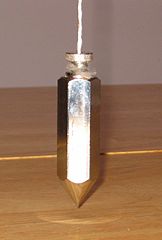
Plumb bob
Plumb bob from Wikipedia Commons
 The last part was Sunday morning worship at Camas Friends Church (a Quaker Meeting).  Peggy brought the message and a plumb bob.  Have you seen one before? It’s a heavy weight on the end of a string that helps to determine the vertical straight line that carpenters use to determine if a building is going up straight. It works because the weight always points to the center of the earth. She compared it to the Love of God, which can help us to orient our lives. The message was also about Truth and Compassion. And I didn’t take very good notes because it was an awe-inspiring message that captured my full attention. When I grow up, I want to know how to preach like Peggy. The Lord knows I will never be that good, but I am taking lessons starting now.

So now what? I know that the ministers who pulled this together are hoping that this Nursery of Truth idea might catch on. And if it did, I think that would be a good thing for the Religious Society of Friends/Friends Church. But how? Would it work to transport these ministers out of their local environment and invite them to speak at your meeting? Yes. Individually or as a group? Yes. Would it help to be conscious of how they went about attracting a not-the-usual-suspects crowd? Yes. Would it work to invite the ministers who are already in your local area to share their practical skills with Friends near you? Yes.

Would it be the same? No. I think that is the catch. God works in those mysterious ways, remember? Trying to replicate specific events or constellations of events becomes discouraging. We need to be open to how the Holy Spirit is leading us every time, all the time, and that is hard.

I think this is the lesson of Quaker open worship – it is different every time, but we need to keep coming back and experiencing the opportunity, even through dry spells, even when you know that people are going to talk about the latest political crisis (in our yearly meetings or in Congress), because we don’t know how or when the Holy Spirit will reach in and grab us by the scruff of the neck and take us to a new place.

Are you ready for that trip over Jordan? I don’t mean dying, I mean going to a strange land where we will have new responsibilities and new opportunities. This “new” land may look surprisingly like the neighborhood where you’ve been living all this time, or it may be thousands of miles away, but it will require new strength and courage to live there. And the basic skills of storytelling and relationship-building and a framework for understanding our place in the Divine story.

For these, I am grateful to the Nursery of Truth, and to Wess, Kathy, and Peggy for having the vision and the courage to bring us together.


All photos from Wess Daniels' Flickr set for Nursery of Truth unless otherwise noted. If you’d like to read more of the real-time commentary, search the Twitter stream for #nurserytruth.

1. Nursery of Truth was one of the names for the island of Barbados where many Quakers coming to the Americas in the 1600s stopped for rest and instruction before arriving in the northern English colonies. To read more, visit  Wess's blogpost.

2. Here is the list of attributes that were sought: Under 30 – AA – NA – LGBTQ – military service – never attended a cross-Quaker event – Work an hourly wage job – attend a Spanish language Friends Church – Rent your home – New Quaker – HS diploma or Associates degree as highest degree – Single parent – have ink or a bike that drinks fossil fuels…

Labels: , , , ,

Subscribe to Post Comments [Atom]

12.08.2012

Necessary but Not Sufficient

I went to a Quaker Revival the other night. Organized by a small group of Christian Friends in the Eastern U.S. and held in West Philadelphia. It fit my idea of a good time.

First, a potluck supper with some Friends I don’t see often enough and some new-to-me people. The house was packed. I didn’t count but I wouldn’t be surprised if there were 50 people there.

Followed by two hours of semi-programmed worship. I would happily have continued in worship much longer – I don’t think the Holy Spirit was done with us by any means. But I had to take my kids home, so I was glad it ended at 9 pm anyway. Well, the meeting for worship ended. The conversations were still going strong when we left.

On that note, why am I (and my husband) the only one who brings her kids to stuff like this? In fact, it worked out pretty well for them. They got to eat what they wanted at the potluck, see and talk to some people they know, sing with the group, pet cats, do their homework and stay up a little (but not too, too) late. On the whole, not such a bad deal from their perspective. It’s important to me that they ARE part of the Quaker community, and the only way to really be part of something is to show up.

For me it was nice that I went, not as a part of my job, but just as a Friend in the community. So I feel like I can write about it here in a different way than if I had been working. On the other hand, I don’t go anywhere anymore without my official (but metaphorical) hat and I know that. Still, probably half the people there didn’t know I was wearing it, and the ones who did know, didn’t care. I’m glad that’s possible.

But, back to what actually happened. There was some singing at the beginning, and then there were three visiting Friends who were asked to prepare a message, and then the rest was unprogrammed worship, with some Bible reading, some more singing, and a variety of messages. It was nice. I enjoyed it. I was not transformed in any noticeable way. Other people seemed generally pleased, some more than others, of course. I think the difference is that it wasn’t exciting to me in the way new things often are, because I’ve done stuff like this before. I asked Chris, “So am I just jaded?” And he said, “Yes.” It reminded me a lot of the convergent dinners that I helped organize over the course of a few years, or the dinners after Quaker Heritage Day. (See SF, LANewbergBerkeleyBoston, Indiana, Baltimore, BerkeleyPhiladelphia).

Another key is not to have too high of expectations. As George Fox learned, when we are hoping for too much from other people, we are often disappointed and disillusioned. If calling it a revival means you’re expecting Azusa St. all over again, you’re going to be sorry. But if you’re open to what the Holy Spirit has to offer in the moment, you will be refreshed.

The important point is that evenings like this shouldn’t be a one time event. They should be a semi-regular event in the life of all Quaker communities. Any time a traveling minister is visiting – the community should gather like this. And that is how we revive ourselves. Revival is not a once and for all kind of event. It is the regular infusion of energy, not in the slow trickle of everyday life, but in cloudbursts of the Holy Spirit among us.

The long-term transformation of lives really happens in the steady flow of service and forgiveness and patience and commitment that we experience in our local meetings. But we need the little jolts of enthusiasm that come from really inspired preaching. We need the friendships and connections that are built in an evening like this. It brought together Friends from several worshipping communities in the area, who live too far apart to do this every week, but ought to know one another in the way of extended family. That too makes a difference over time. The ministry that comes out speaks to different people each time.

It may have been a little gimmicky to call it a Quaker Revival. But it got people to come – a wide range of Friends from 20 miles around. Plus the Holy Spirit. For that, let us be truly thankful.

Labels: , , ,

Subscribe to Post Comments [Atom]
9.17.2012

Bivocational Ministry

So have you heard the term "bivocational ministry" before? If you have, there's a good chance that you've been to seminary, or known someone who did, or thought about going, or taught at one, some time in the last ten years. Or at least, I'm finding a strong correlation in the people I'm talking to.

So here's a short version of what I mean when I say "bivocational ministry":
God calls some people to work in ministry while also working either part or full time in secular jobs to supplement their income.  Bivocational ministry is when a person serves in a ministry while also being employed in a secular job, whether or not they get paid for their religious service. There is a growing conversation among those involved in the training and hiring of pastors, inside and outside the Religious Society of Friends/Friends Church (RSoF), about the need for bivocational ministry. Unprogrammed Friends have been talking more about preparing and supporting all the diverse ministers among us, but may be more familiar with the term “released Friend.”
Bivocational ministry was an essential part of the founding vision of Quakerism, when early Friends railed against the abuses of “hireling ministers.” Even where Friends have hired pastoral staff, we have sought to employ those who are called to the ministry by God, rather than relying on credentials or pedigree. We have acknowledged that a calling to a particular ministry may be for an undefined period of time, and yet not a permanent condition. Throughout our history, with variations depending on the region and the century, Friends have shared the burdens and the joys of ministry widely in our communities. As part of our uniquely Quaker spiritual inheritance, it’s a model that we can share with the world.

Bivocational ministry is quintessentially Quaker, but many meetings and churches are struggling today:
  • Many meetings can’t find enough volunteers to populate their elaborate committee structures. 
  • Even full-time pastors are not equally gifted in all areas of ministry assigned to them by the classic Protestant model. 
  • Many Friends have a calling to do more for their meeting or for the wider Friends Church, but can’t afford the loss of income. 
  • Many pastors are receiving the equivalent of part-time salaries yet expected to do full-time (plus your spouse) work. 
  • Friends from the programmed and unprogrammed traditions are going to seminary to prepare for service to the RSoF, often incurring substantial student debt, but there aren't enough paid jobs in Quakerism to absorb them all.
  • Many meetings and churches don't know what to do with strongly gifted Friends.
  • Friends feel both guilt-ridden and dismissive of their part-time pastors instead of celebrating this balance. 
This conversation touches on many difficult issues for Friends: money, leadership, theology, qualifications for ministry, membership numbers, culture and religious language, to name a few. It is related to a broader economic shift in the world around us, involving both changes in employment and ecological concerns around sustainability. Our society values and rewards single focus dedication, not a balanced life, no matter how many self-help books try to say the opposite.

Many yearly meetings have approached the training and support for bivocational ministers in various ways: weekend workshops, spiritual formation cohorts, pastors’ conferences, support for continuing education. Some local churches and meetings have developed innovative approaches to calling, supporting and releasing ministers. However, most of the best practices among Friends are not well known outside of their immediate geographic area or branch of Friends. The divided branches of the RSoF have a lot to offer one another in tackling the problems and celebrating the strengths of bivocational ministry. Their different perspectives complement each other.

As just one example, an unprogrammed meeting in an unaffiliated yearly meeting that I know had burned out two clerks of their Ministry and Oversight Committee in a row. Several contributing factors were identified, but both of the individuals in question said, “I don’t even want to come to worship on Sundays. It’s not like worship for me any more, it’s just a time when people come to tell me all their problems.” It occurred to a member of their M&O committee that this was a situation that people who are pastors deal with for their whole careers, not just a 1-3 year term on a committee. By inquiring with personal friends who were pastors in evangelical Friends churches, she heard some of their strategies for coping. One said his approach was two-fold. First was to accept that Sunday mornings were his time of service to the community, not his time of communion with the Holy Spirit. Sometimes that happened too, but changing his expectations helped him not to be annoyed when people just wanted to ask him, “where is the big coffee pot?” And second, he had to seek out other times for deep contemplation of the Divine, and he found that in a midweek gathering with other pastors for what was essentially unprogrammed Quaker worship. And so an evangelical Friend had learned from unprogrammed Friends, and a liberal Friend learned from an evangelical Friend. But too few of us know each other to be able to benefit from this learning.

How could Friends address this in a way that would be useful to the whole Religious Society of Friends/Friends Church? To the local meetings and churches that are struggling? For all the people who are struggling to find a way to use their gifts and live into their leadings?

How can meetings and churches have an honest and  conversation with each other and with the individual Friends who are called to serve the RSoF about how to make the best match between gifts and needs?

How can we amplify the work and learning that has already been done about calling, training and supporting ministry, by individual Friends and Quaker institutions, to benefit Friends more widely?

Frankly, I think the survival of the Religious Society of Friends/Friends Church in this century depends on us figuring this out better.

Full disclosure: I am, for the first time in my life, blessed and honored to be paid a full-time living wage for Quaker work. But I know, from 20 years of experience, what it is like for that not to be true. Also, this post reflects my personal leading and not that of my employer.

Labels: , , , , , , ,

Subscribe to Post Comments [Atom]

3.25.2012

Ageless Grace

Last weekend I attended a symposium called “Ageless Grace: Women in Leadership in the Church and in the World” at the Woodstock Theological Center at Georgetown University. There were two main presenters with two responders on stage, and then a period of questions and answers after each. The first presenter was Melanne Verveer, U.S. Ambassador at Large for Global Women’s Issues. The second was M. Cathleen Kaveny, Professor of Law and Theology at Notre Dame University. It reminded me of all the things I loved about my education at a Jesuit university. For Quakers and for Roman Catholics, on our best days, we share a fearless approach to knowledge as a reflection of God in the world.

What follows is not a description of what the speakers said. This blogpost began as I was asked to share my reflections and reactions at the end of the day, but then the event ran over time, for the best of reasons, and I didn’t get to speak, so I’ve tried to arrange my notes into something slightly more coherent. I may still edit this further for a longer article. As a Quaker, an alumna and a woman in church leadership, I was grateful for the opportunity to reflect on my practice with other women theologians.

Some of what I treasure most about Quaker tradition are the examples of my foremothers. Women who preached the Gospel and traveled far and hard in response to God’s leading.

Women many people have heard of, like Lucretia Coffin Mott and Elizabeth Fry. And like Mary Dyer, who was hanged on Boston Common for daring to preach her Quaker heresy in Massachusetts Bay Colony. Or Margaret Fell, the nursing mother of Quakerism, who wrote a tract in 1667 called “Women Speaking: Justified, Proved and Allowed of by the Scriptures, All such as speak by the Spirit and Power of the Lord Jesus and how Women were the first that Preached the Tidings of the Resurrection of Jesus and were sent by Christ’s own Command, before he ascended to the Father, John 20:17.” For more examples, I recommend the book, Daughters of the Light by Rebecca Larson.

These examples are a gift of Quaker history. It’s not that the Religious Society of Friends is or ever has been free of sexism but no one can point to our tradition and say that’s the way it’s supposed to be.

Inspiring examples of Quaker women are not all long ago and far away. It’s not only the province of extraordinary individuals whose example we could never live up to. They include women who are teaching alternatives to violence right now. Women who are pastoring and preparing to preach, right now.

Inspiring examples also include the women who spoke that afternoon. Women who are letting their lives preach as well as their words. Women who are advocating for truth and justice in their church and in the world.

Women my age and younger have so many examples before us. It’s getting a lot harder to be the first woman to do anything. On the other hand, we won’t have to be the first to do everything.

One benefit of the breadth and length of history is seeing multiple examples of how to be a woman in leadership in the church and the world. For me, it is deeply important that I can be a mother and a minister. But not everyone has to do it my way. God calls each of us by name, not by category.

Another gift of Quaker theology is our understanding of the role of the Holy Spirit - how God is speaking to all of us all the time. Our job is to listen, to try to understand with all our faculties, and to obey God’s leading. But fear gets in the way. I think fear is the single greatest obstacle to hearing and obeying when God calls us to change our minds, our practices, our society, our church institutions.

God’s guidance is more like a sacred compass than a GPS. Jesus gives us a steady point to steer by and gauge our progress, not step by step directions to our destination. (Thank you, Brent Bill, for the metaphor.) Two clichés that come to mind as appropriate for this discussion are “the bigger the ship, the longer it takes to turn it around” and “it’s always darkest before the dawn.”

I did get to have my little input after all. The last question that was read was mine. I asked, “Do you think that all the chaotic, painful events in the relationship of church and society these days are the death knell of religion or the birth pangs of a new role for the church/faith community in the world?”

And here’s my answer: Of course it’s both. A lot of old structures are dying, and some of them are thrashing around and shouting loudly on their way out. But because human beings have an innate capacity for and need for spirituality, new ways of being religious are being born. Those structures that “encourage flourishing,” as Cathleen Kaveny put it, will survive.

I pray for the strength and grace to follow God and lead Friends into ways that encourage flourishing.

Labels: , ,

Subscribe to Post Comments [Atom]

9.05.2011

So what do you actually do?

New acquaintance: So what do you actually do in your job?
Me: That's a good question. 
It's funny. I think it's a good sign that I've gotten better at explaining who/what FWCC is without overloading people so that they're not afraid to ask another question. The first question is usually more like this:
New acquaintance: What is the, um, Friends World Committee for Consultation-Section of the Americas?
Me: We are the association of Quaker meetings and churches from Alaska to Bolivia. 
That's my soundbite version. I can say it all in one breath and people understand all the words, even if they don't know anything else about Quakers or what that involves.

Lately, I am inspired by the name of one of our projects that I think encapsulates what we do. Our new website with information about the various branches of Friends and short writings by Quakers on a variety of topics is called Voices of Friends. From my perspective, FWCC is all about helping Friends to listen to one another's voices, helping the outside world to hear the voices of Friends, and helping each of us to hear the voice of God in our own hearts and in the words and actions of other people (and the rest of God's creation). I want to use this imagery more in describing our work.

I'm curious whether this makes sense to other Friends, and whether this connects to what you thought FWCC was/is or not?

So what do I actually do there? My new short answer is that my job is part minister and part manager. A lot of religious education, a little pastoral counseling, some office management, the fundraising and accounting to sustain it all, some P.R. work and some institutional politics, and mostly volunteer organizing (in more religious terms, I call this helping to connect people with their own ministries).

I am considering Brent Bill's suggestion of using released minister as a descriptive title. He was suggesting it for the paid pastoral staff of a local Quaker congregation. Wess Daniels wrote about his adoption of the term in that context. I wonder if it's just as useful in my situation as well. I'm not actually suggesting that we change the title on my business card, which is Executive Secretary, and generally makes people think I'm the admin assistant to the CEO. That would require a different process that I don't have time for right now.

I'm more considering how it feels like I have been released to do the work I really want to do, and that my work is to minister to the whole Religious Society of Friends. The job description isn't very well defined, but essentially I am paid enough to concentrate on the RSoF at the international, inter-branch level, which is always, of course, also at the inter-personal level.  (For anyone who cares, I'm not actually paid enough to support a family without my spouse also working, but it's about average for a non-profit organization with our budget size.)

Part of the reason that the job is hard to define, as any minister or pastor or executive director knows, is that the work shifts and flows over time and space and needs and opportunities and expands to fill all the time and energy you can give it, plus some. The real reason I do it isn't the money, it's the joy and love and excitement I feel at being part of the infrastructure of the RSoF, part of holding it all together and equipping other people to be the Quakers we need in today's world. I would do this work for free, except that if I wasn't getting paid to do this, I'd have to find another job to support my family and then I wouldn't have time to do this work. (See half my blogposts from the last three years if you want to know how well that went. Especially here and here.)

So I am very grateful to have this opportunity to focus on this work. And to do it from a vantage point with systems already in place to implement the work that needs to be done. We don't need more organizations. We need the ones we have to do the work that God is calling us to do, even if that includes a faithful betrayal of the people who came before us.

In the Christian tradition, we are supposedly all released to follow this calling. I think this is part of salvation and being born again. At this point, I'm hearing Bob Dylan in my head, are you? Any day now...

More soon about balancing motherhood and ministry. But that's another blogpost.

Labels: , ,

Subscribe to Post Comments [Atom]

4.18.2011

On My Way

I am on my way today to my first duties as the next Executive Secretary for FWCC Section of the Americas. I don't really start until mid-June, but this week I will meet with the outgoing E.S. and then travel to the FWCC Europe & Middle East Section annual meeting followed by the world Central Executive Committee annual meeting and then the International Planning Committee for the World Conference of Friends that will be held next April in Kenya.

So on Wednesday night, I'm actually headed to Zurich for two weeks. Which still sounds unbelievable and little pretentious, to me anyway, every time I say it. I've never been to Switzerland before, although I have been to France, almost 20 years ago, as part of my work with the international anti-poverty group, ATD Quart Monde, known as the Fourth World Movement in the US.

I don't have a specific role at the international meetings. I'm just going as an observer and a chance to meet in person some of the people I'll be working with in the future. I'll probably come away with plenty of responsibilities for next year, but I don't know what they are yet.

Just in the last few days I've started to deal with the practical aspects of international travel. Like, I need to change some money, and my cell phone won't work in Europe, and I need a special plug adapter for my computer. The last time I went to Europe, the most advanced technology I took was a hairdryer that converted to 110 or 220 current. This time I don't need that but I do want to be able to communicate with my family. We'll use Skype some, but I'm taking recommendations for a global cell phone and an international calling plan that works great in Latin America. Leave me a comment or send me an email if you have suggestions or cautions.

This will be the longest time I've ever been away from my kids. And the longest I've been away from my husband since we got married 17 years ago. Fortunately, my kids are old enough now to be a lot easier to take care of. But there was still grocery shopping and scheduling playdates and team practices, etc.

I finished my work at my old job last week. It was a mixed experience, as so many jobs are, but I learned a lot. About myself, about organizational politics, about succession planning, about social media and the new technology of fundraising.

I'm still thinking about the possibility of starting a new blog for just my FWCC work, but I'm not sure if it's a good idea of not. Will I have time to post regularly in two places? That's a big question. Do I have enough to say to be worth two blogs? And is it really possible to separate my personal life from my public/professional life? Do I want to? I don't really think that people pay attention to the disclaimers like the one at the bottom of this page, that says I don't speak for any organization. I think this is one of the lessons of integrity in the post-Facebook world. I have one life and I have to conduct myself in all parts of it as if all the other parts are watching.

I started this blog for two reasons. First, I wanted to share with my friends what I was reading on other Quaker blogs and what I was thinking about all that. Second, I had all these essays composing themselves in my head and I needed an outlet for them. I used to picture them as lectures in a college classroom. But then I found that a blog was about the right length and frequency for my writing, and came with more feedback/instant gratification than writing magazine articles and made me less likely to harangue my personal friends with my soapbox speeches. Both of those reasons are still true, so don't think I won't keep at least one blog going. Have you had experience writing more than one blog? Does it ever work?

In any case, today is the first day of the rest of my life, as the saying goes. I'm doing the best I can. Deep breath. Everything is going to be all right. I am not in charge. I am not alone. It's not about me. Please, God. Thank you.

Labels: , , ,

Subscribe to Post Comments [Atom]

3.05.2011

FWCC in Philadelphia - Y'all Come Now

So there's a series of interesting things happening in Philadelphia this month. I'm just sorry it's taken me so long to actually write about them. Keep going to the end to read about the convergent dinner party!

First, and the reason that I'll actually be in the area, is the Annual Meeting of the Section of the Americas of the Friends World Committee for Consultation (FWCC). I'm a representative of Pacific Yearly Meeting, and a member of the Wider Quaker Fellowship committee, which is officially a program group of FWCC, and so I'll be attending the business meetings at Friends Center on March 17 and 18.

Following that, there will be a public gathering on Friday, March 18 in the evening and most of the day Saturday, March 19, This is one of a series of local gatherings on the theme of the 6th World Gathering of Friends (that will be April 2012 in Kenya): Being Salt and Light: Friends Living the Kingdom of God in a Broken World. There is a cost of $40 for dinner, lunch & snacks during the sessions, and they are requesting free will donations to support the gathering and the work of FWCC. Child care is available by advance request.

The speakers are Linda and David Kusse-Wolfe, recorded Friends ministers from University Friends Meeting in Wichita, Kansas. Here's the description from the website,
"Linda and David carry a ministry of reconciliation among peoples of different races, classes and cultures. This led them to live and study in Qom, Iran, where they were the only publicly-declared Christians in a city of over one million inhabitants. The Holy City of Qom is the center for education for Shiite Muslim clerics. Linda and David will provide opportunities to relate their experiences to current issues of ‘brokenness’ that Friends are facing in their communities. We hope Friends will take away something that is relevant—both practically and spiritually—to our lives today.

An FWCC program provides time for worship in the manners of Friends, small group sessions and time for fellowship, within the framework of FWCC's mission to bring Friends of varying traditions and cultural experiences together in worship, communications and consultation, to express our common heritage and our Quaker message to the world."

If you'd like to attend, or you know someone else who would be interested, whether they are Quakers or not, you can register online or by mailing in the form that's available from the same page on the FWCC website.

And last, but by all means not least, there will be a convergent Friends/blogger get together on Saturday night at Eileen Flanagan's house!
(info on Facebook) (info on QuakerQuaker)

This is the first time that I'll be in the Philly area for more than a day or so, so I'm grateful that Martin Kelley is helping to organize things. And I'm very grateful to Eileen for having us over. She'd like to have a rough idea of how many people are coming, so please RSVP on one of the above event pages or leave me a comment, or email her directly.

I think that we're going to order pizza for dinner, so be prepared that we'll take up a little collection towards that, and if you would like to bring something to share (to drink, a side dish, dessert, an alternative that you prefer to pizza...) that would be great.

Over the last five years, I've been to little gatherings like this in San Francisco, Berkeley, Los Angeles, Newberg (OR), Baltimore, rural Indiana, Greensboro (NC), and Boston. They have ranged from 4 to 24 people, in homes, parks and meetinghouses. They have all been different, but they all featured interesting conversations, usually with people from 2-8 different yearly meetings. The best have included a time of worship sharing on some query that helps us to see how each other is wrestling with the question of how to be Friends in the 21st century. The amazing thing to me is how often unexpected people show up who enrich and expand the conversation just by being there.

If you'd like to join this conversation, you are invited. You can find more details on how to get there on the QQ or Facebook pages, or you can email me at the address in the sidebar. If you have questions, please leave me a comment on this post, or email me or Martin Kelley directly.

And if you're not going to be in the Philadelphia area this month, maybe we can talk about how to organize something like this in your area - both the Salt & Light gatherings and the convergent Friends dinners are a mobile feast!

Labels: , ,

Subscribe to Post Comments [Atom]

2.25.2011

Faithful Betrayal

On Sunday morning after Quaker Heritage Day, Wess “brought the message” to worship at Berkeley Friends Church. He told a parable about the master and the perfect disciple. You can read more of it in his article that was in the Jan/Feb 2010 issue of Quaker Life. Essentially, the disciple swears never to deviate from the Master’s teachings, and the Master says that to swear this is already to betray his teaching.

Wess was making a reference to how the Christian Church in postmodern culture has to break with some of the traditions that have been handed down to us. I think the lesson is that in order to be faithful to our highest or greatest calling, to be faithful to God, we may have to break with or betray some of our human teachers.

For Quakers, this may mean several things.

First is that we have to examine the taboos that we have inherited, like we can’t talk about X topic, or with those people (insert your favorite here). Depending on where you came to Quakerism, that may mean we actually have to talk about what we believe, whether that is a more or less orthodox understanding of Christianity, or it may mean we have to admit our doubts or that our interpretation has changed, of the Bible, or George Fox’s Journal, or whatever.

Second is that the way we do business, or worship, or nominations may have to change. Again. None of us is a Quaker in exactly the same way that 17th century Friends were. We may resume some old practices; we may borrow from those other Quakers; we may choose something that fits with our local cultural or generational norms. Here I recommend reading Brent Bill’s Modest Proposal (which is a lot less shocking and a lot more practical than Swift’s essay by the same name).

Third is that the institutions we have been handed may not be the instruments we need to achieve God’s kingdom in our times. Do our meetings need different (or fewer) committees that what we’ve had for the last ten years? Do our churches need to separate into smaller worship groups? Or join into larger congregations? Do we need some form of realignment of our allegiances and associations? (I know that word has history and heavy baggage, but I mean to invoke all of that, or at least some of that heat and light.)

How is God calling us to “be the Quakers” in 2011?

Where are the nudges in your personal life? What courage will it take to speak your understanding of the Truth?

What support do we need from each other to lay down the forms and patterns that no longer serve God’s purposes, no matter how useful they may have been when they were innovations?

And how will we know what is truly faithful in the face of the sense of betrayal that others will feel about our new leadings? How hard is it to tell somebody, “I know you’ve dedicated the last thirty years of your life to that committee, but it doesn’t exist anymore.”?

The fact is that those conversations are going on already. In monthly meetings. In yearly meetings. In international organizations. Some of this work has been hastened by the financial crisis. But most of it is due to the generational shifts, the Great Turning, the Great Emergence, that is happening all around us, whether we like it or not.

To swear never to deviate from the paths of our great teachers is to have betrayed them already.

Labels: , , , , ,

Subscribe to Post Comments [Atom]

2.23.2011

A New Mission for the Church?

Another post on Quaker Heritage Day 2011. For more, see my earlier posts. For my inspiration, all credit goes to God, C. Wess Daniels, and the awesome Friends who were part of the discussion.

Wess's first topic of the day (after his introduction) was a redefinition of the word mission. I feel like it was an opportunity to reclaim the word, much like Carol Spencer inspired me to reclaim the word holiness last year. He started by asking us what associations we had with the word and these ranged all over, from the saving of souls to military campaigns. I personally think of the haunting movie with Jeremy Irons & Robert DeNiro, The Mission.

As I see it now, the word "mission" for a postmodern church or meeting means something combining the secular nonprofit organizational meaning of a purpose for being, as in a mission statement, and the Quaker meaning of a leading, or a God-directed purpose. It means the work that a particular church or meeting is called to do and be, and Divinely fitted to do, and needed to do. I think it could be related to Walter Wink's concept of the angel of an institution, but I don't really feel qualified to address that connection.

So then Wess proposed a very interesting idea, that the mission of the church, broadly speaking, is to be a midwife to the spiritual life, of an individual or a community. Here are some of the interesting points that were generated:
(some come from Wess and some from the audience, they built on each other)
  • the midwife brings experience and training
  • the midwife trusts the mother to be competent
  • the midwife is not in charge or control of the labor
  • the midwife is not the baby or the impregnator of the mother, nor the one doing the labor, nor the one who will keep the baby
  • the midwife serves a particular area; she is mobile but not homeless
  • the midwife doesn't show up where she's not wanted or just on game day
  • the midwife is committed to the whole process, for better or worse, regardless of outcomes
Now substitute "minister" or "the church" for the "midwife" and read the list out loud to yourself.

The church trains and prepares and brings faith that a person or community can have, already has, a spiritual life. The church/minister has the role of accompanying the person who's developing their spiritual life - not in charge of creating it or saying where it will go, although they may have some experience of seeing how things often progress, and can be reassuring along the way. The church has to be flexible but not unmoored. A minister serves a community as a whole and people as individuals. The church has to be in it for the long haul.

I know I want to spend more time contemplating and discussing this image. Does it speak to you? Would your meeting or church be open to thinking about its purpose this way?

Labels: , , ,

Subscribe to Post Comments [Atom]

2.21.2011

Follow up on QHD 2011

The short version is "It was great." Here's the link to my list of hopes and expectations, and I think I can say the whole event lived up to most of them.

The longer version is, by definition, more complicated and some of it is still reverberating in my brain and will therefore take longer to write about. But I didn't want to wait anymore to write a little bit about it.

As I've said before, Quaker Heritage Day is an important annual event in my spiritual journey. This year, the speaker was C. Wess Daniels, released minister from Camas Friends Church, in WA, near Portland, OR. I first met Wess in person at QHD in 2006. He is still a Ph.D. candidate at Fuller Seminary and he presented some of his material from his dissertation research. It was challenging in a intellectual way, like a college level class on Quakerism. Here are the slides & other documents from his presentation. It opened up new connections between Quaker history and postmodern culture, in a way that offers me hope for the relevance and vitality of Quakerism in the future. The four points I'd like to highlight (and write more about) were the redefinition of mission, the role of the church as midwife to the spiritual life of a community, Quakers as exemplars of fan culture, especially as remixers and participatory producers, and the role of faithful betrayal in spiritual matters.

I think my role in this event is as an engaged fan of QHD, in the technical sense of fan culture that Wess described. I helped spread the word; I encouraged more young Friends from a wider geographical area to come; I helped support the child care, and I coordinated the after-party. I am enthusiastic about the stimulation I receive from QHD and I just assumed that I could help in some way. Which may be irritating to the real organizers at times but I think overall it makes for a better event. Or I'd have stopped by now.

There are some photos on Facebook. Lisa H. wrote two good posts on Quakers and Remix Culture, (part 1 and part 2) and Chris M. shared some of his own further reflections. I hope to write up posts on the four points I mentioned in the next week or six, in between everything else that I have going on. God willing, and the internet connection doesn't bail out again.

And next year, you should really think about coming. It's not a balloons & facepaint type of party, although I apparently gave that impression to some local Friends, for which I apologize, but it's a good time for Quaker thinkers.

Labels: , , ,

Subscribe to Post Comments [Atom]

1.18.2011

Quaker Heritage Day 2011!

What: Heralding the New Creation: Mission as Participation in the Quaker Tradition
C. Wess Daniels will help us think about the renewal of our tradition through a renewal of mission. He will touch on the first Friends’ understanding of their mission, the way that 20th century evangelical Friend Everett Cattell thought about it, the ways that convergent Friends today are building new communities online and face-to-face, and how our local meetings and churches can live out the new creation by fostering a participatory culture. (download flyer)

Who: C. Wess Daniels (Wess is the released minister of Camas Friends Church, a father of two (really cool) little girls, a husband and a doctoral student at Fuller Theological Seminary. Among his many interests are nourishing Christ-centered faith, encouraging cross-branch friendships in the Religious Society of Friends and trying to start what he calls the “Quaker Revolution.” But since things happen closer to the pace of evolution among Friends, he spends the rest of his days enjoying tasty locally roasted coffee, reading books that make him look smarter than he really is, playing imaginative games with his daughters, and learning how to watch for unexpected moments of grace. He blogs at gatheringinlight.com)

When: February 12, 2011, 9-4 (plus optional dinner on Saturday night and worship on Sunday morning)

Where: Berkeley Friends Church 1600 Sacramento St Berkeley, CA 94702
Corner of Cedar Street, 2 blocks north of North Berkeley BART station.
Telephone (510) 524-4112 www.berkeleyfriendschurch.org /qhd

Why: Because it could change how you think about the future of Friends


My own spiritual journey has been forever changed because of my experiences with Quaker Heritage Day. You can read what I’ve written about it over the last five years here and in the October 2006 issue of Friends Journal (my article is not online).

Okay, I don’t want to raise people’s expectations beyond what Wess could possibly meet. But I do want to encourage everybody who reads this to come. Especially if you have any hope of being around Friends for the next forty years or more.

Here’s what I expect:

I expect to be engaged more than just sitting and listening all day. Wess is good at creating interactive and worshipful exercises.

I expect to be challenged. My horizons have been broadened a lot already in the last five years. I first met Wess at QHD in 2006 and he had already made me think outside my usual boxes just from reading his blog. But I still expect to hear things that make me question them and myself.

I expect to make new connections between the past and the future – how Quaker traditions can speak to us today and transform us for the future.

I expect to laugh. Wess has a dry and self-deprecating sense of humor and a fine appreciation for the absurdities of life and Quakerism.

Here’s what I hope:

I hope it will be an intergenerational event. I hope for equal numbers of people over and under 40. [Note to YAF: Come and bring your friends!!!]

I hope it will draw Friends from a wide range of geography. I think it would be worth coming from out of town for the weekend. If you need help finding a place to stay, let me know.

I hope it will draw Friends from a wide range of theology. I think Wess’s presentation will appeal to many Friends, even as it challenges each of us in different ways.

I hope Wess is brave in sharing what he really thinks. One of the previous QHD speakers didn’t go far enough, I think he pulled his punches, so to speak, and the Day suffered. It was still interesting but it wasn’t amazing.

I hope that someone in the Berkeley area will want to host dinner afterwards. We can order pizza delivered, so no cooking is required. But a place where folks can hang out, where kids can be safely, where we won’t be bothering the roommates or the waitstaff, that would be great. If you or someone you know could host, call or email me. I’m in the College Park Quarterly Meeting Directory and my email is in my profile in the sidebar. I’ve had a couple of offers in SF, but it would make more sense to stay in Berkeley.

Registration is by mail or by phone to Berkeley Friends Church. The event is free and open to all, but the suggested donation is $20 with lunch; $15 without. Donations are gratefully accepted and support this annual event. Make checks out to Berkeley Friends Church with ”Quaker Heritage Day” in the memo line. Child care is available with advance registration. I expect that my kids will be there, so they'd be really grateful if you would bring yours.

Labels: , ,

Subscribe to Post Comments [Atom]

10.09.2010

Help Wanted 2010

There's been a fair amount of buzz in the Quaker blogosphere lately (and over the last five years) about Revitalizing the Message and New Wineskins. This is part of a more general debate about the fate and usefulness of old Quaker institutions. I think it is very important to have these discussions on an ongoing basis. But pontificating on the internet is not enough. What are we going to do about the state of the Religious Society of Friends?

On that note, have you noticed how many of the major Quaker institutions (and a few minor ones) have been or are now, or will be soon, looking for new executive leadership in the course of about two years?
American Friends Service Committee (2010)
Ben Lomond Quaker Center (2011)
Friends Committee on National Legislation (2010)
Friends General Conference (2011)
Friends Journal (2011)
Friends United Meeting (nominated 2010, starting 2012)
Friends World Committee for Consultation (2011)
Philadelphia Yearly Meeting (2008)
Quaker House (in Fayetteville, NC) (2012)
Western Friend (2008)
There’s probably more. Which ones have I left out? (Is there a clearinghouse somewhere for announcements and job descriptions?)

***Here's two more:
QUNO Geneva [added thanks to Eden Grace, 10/9]
Earlham College [brought to my attention by Martin Kelley, 12/8]
***And even more, now with dates thanks to Kathy Hyzy, 1/27/11:
Woolman Semester (2008)
Friends Fiduciary Corporation (2011)
Quaker Earthcare Witness (2011)
Quaker United Nations Office/New York (2008)
Northwest Yearly Meeting (2012)
One Friend I know got interviewed for one of these jobs and the first question the committee asked was, “Out of all the Quaker jobs open right now, why do you want this one?”

Why do you think this is all happening at once? Is it just time in the generational cycle? Is it because the financial crisis of the last couple of years has been so hard on executive directors?

This looks like a wider nonprofit trend of long-time executive leaders leaving. About 10 years ago, there was a big fuss in the nonprofit world about a survey that showed that half of all executive directors planned to leave their jobs in the next five years. Then five years ago, another survey showed that the massive shift hadn’t happened but that most EDs still planned to leave in the next five years. I think that we are now seeing that shift starting to happen among the Baby Boomers who founded organizations in the 70s and 80s. It’s complicated by the economic recession, and by the fact that Boomers are living longer in better health and so working longer too. I highly recommend a book by Frances Kunreuther, Helen Kim and Robby Rodriguez, called Working Across Generations: Defining the Future of Nonprofit Leadership.

I don’t know enough about evangelical Friends organizations, but there aren’t any on this list. Why not? Did they already go through a shift or are they just about to enter this phase? Or am I just not in their loop?

I’m wondering how many of these jobs will go to another Baby Boomer. (It’s two out of three for the ones I know of that are already filled.) [Update: Seven out of ten as of February 2011.] What kinds of risks are the hiring committees/boards willing to take on less experienced Friends? Will they just hire another Boomer to stay another 2-5 years? Will we have another generation of 20-30 year tenures at the tops of these of organizations?

Will all these institutions survive this once in a lifetime mass shift in leadership? How many will move in new and vibrant directions? Are there too many openings at one time? Are there enough younger Friends who are ready, willing and able to take on new responsibilities? To take on the hard work and hard choices? To commit?

New wine needs new wineskins with every harvest. But not a whole new winecellar every year, just to continue the metaphor. I don’t want to reinvent the wheel just for the sake of saying “I did it my way,” or “We sure showed them.” Then again, when your winecellar starts to cave in, it may be time to move the whole house.

Organizations help to coordinate the matching of resources with missions. Structure can be helpful. Systems liberate. Creativity flourishes best without complete chaos surrounding it. One lone ranger, or a small, committed group of citizens, can do some things for a short time, but organizing materials, money and manpower takes infrastructure to run smoothly. What would a GenX Quaker institution look like? What about a Millenial Quaker organization?

Honestly, I don’t know or even have a fixed opinion on what should happen. These organizations vary widely in size, complexity and mission. Some are on firmer financial and spiritual footings than others. But all will depend on, contribute to, and have to face either the diminishment or the revitalization of the Religious Society of Friends.

In an era of reduced budgets and growing unrest, what does the future hold for the Religious Society of Friends?

Where do you see yourself?

Labels: , , , , , ,

Subscribe to Post Comments [Atom]

4.28.2010

Two May workshops at Pendle Hill

More stuff I wish I was going to, but I’m not. Just because I live in California and I have a full time job and a family to take care of, and not an unlimited supply of money or frequent flyer miles or vacation days.

But you. If you can make it to either or both of these, let me know. I could offer you a guest posting gig right here on this blog. Inquiring minds want to know how it goes.

First, New Monastics and Convergent Friends, May 14-16, with Martin Kelley and Wess Daniels. Martin and Wess I count as personal friends as well as public Friends. They are two of the most innovative thinkers about Quakerism that I know and I’d love to spend the weekend hanging out and talking Quaker stuff with them, no matter what the specific topic. Plus I co-led a workshop with the two of them last year and it was fun.

Second, The Practice of Simplicity, May 28-30, with Erin Rooney Doland. She’s a member of Herndon Meeting in Virginia and the Editor-in-Chief of Unclutterer.com, an awesome blog about how to deal with stuff. I don’t follow many non-religious blogs, but this one is on my frequent reading list. And she reads my blog, at least sometimes.

Erin says that “the theme behind the weekend is ‘Making room for Light.’ We practice simple living (and I mean practice in the same sense you might practice a sport or practice the piano) because we want God to have room in our lives. When we fill our schedules, homes, offices, lives with stuff, Stuff, STUFF, the Light gets pushed aside. Through this weekend retreat, my hope is that people can take time to reflect, pray, and listen in the silence to help them reconnect with the Light and make room for it to grow in their lives.”

She also has a new book out, How to Unclutter Your Life in One Week, so if you can’t go to the workshop, there’s another possibility. But I think the weekend will have more spiritual content than the book, which is more on the very practical end of things. In my experience, you can get rid of a lot of physical stuff, but if you don’t sort out your spiritual and emotional life, the physical stuff will just pile up again.

There's more information about both workshops including registration and scholarships on the Pendle Hill website.

Labels: , ,

Subscribe to Post Comments [Atom]

4.05.2010

Holiness: The Soul of Quakerism

A review and further reflections on Holiness: The Soul of Quakerism by Carole Dale Spencer

I’m trying to remember where I first heard of this book, and I can’t recall. I do know that I asked for it for Christmas in 2008, and thanks to my beloved Chris M., it’s been sitting on my shelf ever since, waiting for me to finish it.

I finally did it, because Spencer is coming to Quaker Heritage Day in Berkeley next week. It’s a tough read, if you’re not used to the academic style, but it gets easier near the end. And I’m really, really glad I read it.

A lot of the book is Spencer running through a series of individuals through Quaker history and showing how they are or are not exemplars of Quaker holiness. There’s more than 20 of them over 350 years, so if you want to know who they all are, read the book. Some of the history doesn’t agree with what I’ve learned – but then I only know what others have said about most of them. I agree with her interpretations of the ones I’ve read first hand: Hannah Whitall Smith and Richard Foster and Thomas Kelly. Elias Hicks, Joseph John Gurney and John Wilbur, these are three I’d like to read more of. (I’ve got the new version of Hicks’ Journal, which I understand addresses some of her criticisms.) I wouldn’t call myself a Beanite Friend, partly because I think that sounds silly, partly because I don’t think of myself as a follower of a particular Quaker ancestor, and partly because I don’t know enough of Joel Bean’s actual work to have a valid opinion. More and more I think I should read his work myself.

But I’m less interested in the historical aspects than in my own affinity for the key elements of Quaker holiness. I think this could be a key to what holds convergent Friends together in my mind. Or maybe it’s just the key to my own spiritual journey.

I think it’s important to separate the current iteration of non-Quaker holiness movements from what Spencer and I are talking about. Apparently, Quakers have always had a slightly different definition of holiness from the religious mainstream. Meaning we don’t have to equate holiness with American rightwing politics and religious fundamentalists. Actually quite the opposite, in some cases.

Spencer teases out eight separate elements of traditional Quaker holiness. I’ll list them here, because I’m copying them from the book: Scripture, Eschatology, Conversion, Evangelism, Charisma, Suffering, Mysticism, Perfection.

Spencer also explains how these elements relate to evangelical concepts like justification and sanctification, but I can’t keep them straight. Frankly, I think that Conversion and Evangelism are two parts of the same thing, and that Suffering and Perfection are another inseparable pair. And if you’ve got an hour or two, I’d be happy to sit down and explain why I think so and discuss it with you. I could use the help in working it all out in my own head. But for the purposes of this book review, let me just encourage you to read Spencer’s explanations of what each means.

Personally, I can only manage to keep three aspects in my head, in part because I think they are all inter-related and they all cycle around to each other.

1) Perfection, meaning holy obedience, spiritual growth, acting like Jesus, living up to the Light we’ve been given, actually doing what we know is right
2) Mysticism – listening to God, hearing Christ Jesus speak to my condition, cultivating and holding close to the intimate relationship with God
3) Witness, which in my mind includes spreading the word, sharing the Good News, working to improve the world, teaching and healing like Jesus.

The desire for holy perfection and faithful witness, the understanding of their meaning, and the strength to accomplish them come from our mystical relationship with God. I think that when Friends have kept close to that guide, then we have avoided falling into the rigid and rulebound forms of religion. I think that scripture is a tool to be used with our mystical interpretation. The Bible may not be perfect, but it’s the best description of Jesus’s teaching and actions that we’ve got.

I have three examples of how perfection and witness are related, but none of them comes from Spencer’s book so don’t blame her if they don’t speak to you. One is that we know that having a low flow showerhead isn’t going to save the world, but it helps to have your own house in order before you try to change farmers’ wasteful irrigation practices. Second, you can’t effectively protest factory working conditions while wearing clothes made in sweatshops. Third, people are more likely to listen to you tell them how Jesus is a blessing in your life if you are a blessing to your family and friends.

Now I know that these aren’t strict rules, and it’s not true that we can’t say anything about the wrongs of the world until we’re free from all our sins. But we have to be actively examining our own lives for the seeds of war and continually doing something about our own lives as we go along. And then we can speak with Truth and Power. Part of this is the confidence that comes with not feeling like a hypocrite and the recognition from one’s opponent that one is walking the walk. But I truly think there is something divinely inspired that makes a person a better advocate who has removed the beam from her own eye without getting bogged down in that process. Jesus offers us some good examples of looking at rules, and acting with love, even if, on occasion, that contradicts a generally useful rule. (Like healing on the Sabbath, for example.)

I think Spencer is right that our various forms of worship are culturally and temporally specific, not divinely mandated. What’s important is that our worship enables us to achieve communion with God – to hear God speaking to us. Hours and hours of silence seem intensely important to me, and absolutely fruitless to others. I’m willing to accept that other people experience God in other ways. (I don’t believe this is divided along lines of race, class or geography, but I know that what we’re used to makes a big difference.)

What is missing from this book is the growing holiness movement among unprogrammed Friends in the last ten to twenty years. That’s probably because we don’t call it that usually. But I think that Lloyd Lee Wilson’s book, Essays on a Quaker Vision of Gospel Order, fits all of Spencer’s criteria for Quaker holiness. I think some (not all) of our Quaker environmentalists are actually part of a holiness movement. In my local world, I think that the reason that Chris Moore-Backman’s and Carl Magruder’s ministries are so attractive to some and so off-putting to others is because they are actually preaching Quaker holiness. They’re just not using that word.

And then there’s me. Not that I am such a stellar example of Christian perfection. But I want to affirm that I’m really trying, on all these points. I’m just now understanding that this Quaker holiness is what calls to me in the Friends that I would call convergent. Do you feel the same way?

In all the branches of Friends, in all eras, there have been examples of Quaker holiness, real people who have touched the lives of the people around them, even if they didn’t publish any books or start any new movements bearing their names. Think about who you know that you admire as a Quaker. In what ways do they exemplify Quaker holiness? In what ways do they contradict my theory? You don’t have to name them here on this blog, but I’m really curious whether this idea resonates with other Friends or not.

Labels: , , , ,

Subscribe to Post Comments [Atom]

3.22.2010

FWCC 2010: Worship, Old Town, and an Idea for the Future

I try to call home each night when I’m traveling, after dinner but before bedtimes. Last night, as I talked to each of my sons, I told them, “I got to go to worship three times today.” Both of them, independently, just said, “Wow.” I don’t think they envied me. But I was happy about it. Each worship opportunity was quite different.

First was morning worship at the FWCC Section of the Americas Annual Meeting, organized by the Conservative Friends. Perhaps surprisingly, they were the only ones to make use of the audio-visual (AV) equipment in worship. They had a single slide projected on the wall at the front of the room that said something like, “We are already engaged in worship. Please join us in expectant waiting upon the Lord.” Then it quoted Advice # 24 of Ohio Yearly Meeting to encourage Friends not to quench the Holy Spirit but to respond when the call to vocal ministry comes. I think this was a good example of advices being written for a particular community that are beneficial to a wider range of people. I imagine that among programmed Friends there could also be a tendency to think that vocal ministry is only for a few people. (In my own yearly meeting’s advices, there are reminders that not every thought that comes into your head is meant for vocal ministry and that if a particular piece of ministry doesn’t appeal to you, you can just let it go.)

The second opportunity was the closing worship at FWCC, which was organized by a very international group of young adult Friends. It opened with a moment of silent worship, then there was a passage of scripture read in English by a young man from Kenya and in Spanish by a young woman from Bolivia, with commentary by the Friend from Kenya. There
was another short period of silence, then a small group including North American Friends led us in a song,and then another period of silence.

Next was supposed to be a message by a very young pastor from Guatemala, but instead some woman got up in the silence to read a Native American prayer that she “just happened to have with [her].” I’m sure she felt deeply moved, but I still think it was rude to interrupt a programmed worship service like that. The Friend from Guatemala did a fine job anyway, but it’s hard to be preparing to preach and then have it unexpectedly postponed.

This really brings up for me the question of what is the purpose of silence in a programmed worship service. I think there’s a difference between a period of open worship which is intended for Friends to speak as moved and a few minutes between elements of the program to let a message sink in or to open ourselves to the next element.

Anyway, then we sang another song and then it closed with a prayer by a young woman from a Hispanic Friends Church in the U.S.

The third opportunity for worship was with an emerging Quaker worship group in Baltimore, Old Town Friends Fellowship. Several months ago, I realized that if I was going to Baltimore anyway, this was a chance to visit this group I’ve been hearing about, that has been worshipping together, in various places, for about two years now.

It was a chance for a little bit of FWCC to come to local Friends, and a chance to support this small worship group. This second purpose turned out to be more important than we could have known in advance. Just hours before we gathered, the worship group’s request to be taken under the care of Baltimore Meeting – Homewood was turned down. The worship group folks were really very gracious about the decision, but I was personally shocked. I am certain that there is more to the story than I know, or than could be shared on this outsider’s blog, but I just don’t understand a decision like that. The Old Town Friends will go on, and way will open somewhere else, another day. However, it felt really good to be with them on a depressing day like this. I’m glad that a much larger group came to worship with them, to hold them in the Light, to hear their stories, and to affirm the Holy Presence in their midst.

I arrived with Nancy C, a Friend from North Carolina Yearly Meeting (Conservative), who gave me a ride. Fortunately, it was on her way south anyway. David M, from Ohio Yearly Meeting, met us there. Susanna R, Clerk of the Oldtown Friends, welcomed us to the Aisquith St Meetinghouse, the oldest house of worship in Baltimore. (More history here.) Other local Friends soon joined us for some juice and cookies. Bill Samuel, a long time Friend now attending Cedar Ridge Community Church, and an occasional commenter on this blog came in person as did Stephen D, who came to the convergent Friends workshop at BLQC last year. Joan L, who participated in my workshop at FGC in 2008, and her husband Rich are semi-regular attenders at Old Town Friends, as is Ken S. Other Friends came from the DC and Baltimore areas. Martin Kelley and his whole family came, although Julie and the boys didn’t stay for the whole worship period. Altogether, I counted 19 people, from 5-6 Yearly Meetings.

We started with reading Propositions 5 & 6 from Barclay’s Apology and a lively discussion of the possibilities and limits of universal salvation, of free will vs. God’s power to save. It was interesting to be in a group with some people who have clearly read and studied Barclay at length and people like me who are just reading it for the first time. I didn’t realize before that the original 15 Propositions are not that long. A lot of what is published as Barclay’s Apology are his later refutations of his contemporaries’ criticism of his points. I think I could read just the Propositions a lot sooner than I would be motivated to read the whole enormous book, even in the modern English version. They are available online or through Quaker Books. I also recommend Will T’s series of blogposts on Barclay, starting in 2006. If this encourages anybody else to read it, let me know.

Then we moved over to the other side of the room for worship. The meetinghouse still has the original partitions for the men’s and women’s meetings, but the building has been adapted slightly for another worship group that meets there on Sunday mornings. Their AV and praise band equipment, including full drum kit, are set up on what used to be the facing benches. The acoustics are really good in the building that at one time held 350 people for worship.

We began with introductions, then joys and concerns, then a couple of Taize chants, led by Kevin-Douglas Olive’s fine voice, and then about 45 minutes of open worship, followed by announcements. We had a really good discussion of how the worship group can welcome children to worship with them in the future.

And last we had potluck. As with Friends everywhere, the food was good and plentiful, and the opportunity to talk with old and new Friends was wonderful.

I am very grateful to Oldtown Friends for welcoming us into their normal routine. I am so glad to have had the opportunity to worship with them. Each year, when I have made the time to stay over after the FWCC meeting for a visit with local Friends, it has been so enriching for me. I think it has also been a gift to the local Friends to have some of the diversity of FWCC come into their regular lives, not just as a conference but as intervisitation. I also know that many of the Latin American Friends were hosted this same evening by the Iglesia Evangelica de los Amigos de Baltimore, and I expect that interaction was also valuable for visitors and locals.

It is the hope of many in FWCC Section of the Americas that the proposal to hold a series of local gatherings on the Being Salt and Light in a Broken World theme in preparation for the 2012 World Gathering of Friends will also give some of this rich experience to many more Friends in the next couple of years. I encourage all of you who read this to find out what the plans are in your area. Ask the FWCC reps from your yearly meeting. See if you can help make it happen.

If you are an Evangelical Friend, please think hard about how you can encourage other Evangelical Friends to participate in the World Gathering itself, and in local convergent gatherings in their areas, especially if they are not used to working with other Friends near them.

For everyone who has wished for something convergent to happen near you – this is it, folks. It’s not the only thing, of course, but this project is coming to a location near you some time in the next two years. If you need to start saving now for a trip to the next state, or if you have always wanted to visit Friends in another region of the Americas – Friends in that region would be so happy to have YOU come.

More information will become available over the next few months. Since the proposal was only approved on Saturday morning, not all of the plans are clear yet. But this could be a amazing opportunity for Friends everywhere to connect with the wider world of Friends, to find the kindred spirits out there, the ones we already have something in common with but we just haven’t met yet, and to influence the voice of Friends in the world. And this time, we have all the institutional support of FWCC Secion of the Americas: staff, committees, relationships, experience, fundraising and vision.

Dear God, please help us to see with your eyes the possibilities for Friends to truly be salt and light in the world. Help us to hear with your ears the cries of the world, the suffering of the poor and of the lost. Help us to listen to voices we have ignored before. Help us to mend our broken covenant to share the Earth with all creation and with all generations to come. Help us to be models of righteousness and right sharing. Help us to be brave when we are afraid and humble when we are right and when we are wrong. Help us to feel where the winds of the Spirit are blowing, to welcome the new things that you are doing, and to be patient for the arrival of the fruits of the Spirit. Amen.

Friends, is this the vision for the appointed time?

Labels: , ,

Subscribe to Post Comments [Atom]

3.17.2010

FWCC and Convergent Friends, v.2010

Three years ago, I went to my first FWCC meeting. It was quite a production to leave my family for a week and go all the way across the country. I'd like to write more about how things have changed for me since then, but for tonight, I'll just offer some quick notes. I know more about FWCC now. I actually have less responsibility this time than that first time. But the biggest change is just that my sons are three years older now, and I'm less worried about leaving my family to fend for themselves. And I've gotten some good advice in the last few years about traveling in the ministry and the re-entry process, including Watch What You Fill Up On.

I will blog some from the sessions and then probably write more when I get home. Plus my review of Philip Gulley's If The Church Were Christian... will be published here on March 25.

And if you're anywhere in the mid-Atlantic region, join me (and Martin Kelley) in visiting the Oldtown Friends Fellowship on Sunday, March 21, 2010 in downtown Baltimore. Read more about it on QuakerQuaker.org Here is an old report from an earlier gathering like this, in Boston.

Labels: , ,

Subscribe to Post Comments [Atom]

2.18.2010

Opportunities in Spring 2010

Whenever I’m going to an interesting Quaker gathering, I try to write about them on my blog to encourage others to come. There are two such opportunities coming up in the next few months.

The first event is the Annual Meeting of the Section of the Americas of the Friends World Committee for Consultation. This year it’s being hosted by Baltimore Yearly Meeting, at a camp near Reistertown, Maryland, a little northwest of the city of Baltimore. The dates are March 17-21, 2010. Registration is still open through February 22. For local Friends, there are opportunities to attend the evening sessions without registering for the whole thing or staying overnight. The website has more details.

As long time readers of this blog know, my appointment as a representative of Pacific Yearly Meeting to the Friends World Committee for Consultation has been a great gift to me. The opportunity to travel each year to a different part of the Quaker world has opened many new doors. This all began four years ago when I was invited to help lead a workshop during the sessions about convergent Friends, with Wess Daniels, Shawna Roberts, and David Male. You can read more about these prior events – click on the tag FWCC at the bottom of this post for more of my blogposts.

The second is Quaker Heritage Day on April 10, 2010. Every year, Berkeley Friends Church hosts a day long seminar with a well known Friend (or two) on a topic that connects Quaker history with our contemporary practice. This year the speaker is Carole Dale Spencer, author of Holiness: the Soul of Quakerism, from Northwest Yearly Meeting. Here’s part of the description from the flyer:
“Holiness is an idea that has been more divisive than uniting for the Society of Friends. Yet it was unmistakably important in the experience and faith of the first Quakers. Carole Spencer maintains that holiness, while neglected by many Friends today, provides an ‘ongoing thread that serves as the common denominator of normative Quakerism’. Nor was holiness solely the domain of nineteenth-century revivalist Friends. In fact, we can see various aspects of holiness in the lives of Quakers throughout our history and in each of our divergent traditions. What's more, understanding holiness as a ‘spiritual quality in which human life is ordered and lived out as to be consciously centered in God’ opens the way for us to see the possibilities for our own lives, whether we might consider ourselves to be evangelical, liberal, mystical, or some other kind of Friends.”
The program opens with breakfast and a book table at 9:00 with the speaker beginning at 9:30 am, lunch break at 12:45, and closing worship begins at 3:00 pm. The event is technically free, although the suggested donation is $20 with lunch, $15 without. Child care is available if requested before March 21, 2010. (I’ve already put in my request for two boys, ages 8 and 11.) The registration form is now online or you can call 510-524-4112.

I can clearly trace the origins of the phrase convergent Friends to a dinner party after QHD in 2006 that radically changed my understanding of the Quaker world. I met Wess and Emily Daniels, Max Hansen, Margery Post Abbott and Peggy Senger Parsons. I wrote about that experience in Friends Journal in the fall of 2006. You can find more of my blogposts about previous QHD events by clicking on the QHD tag at the end of this post.

One thing that I have treasured in addition to the regular conference experience of these gatherings is the opportunity to meet with local Friends, readers of this blog, writers of other blogs, local Friends who are interested in meeting Friends across the Quaker spectrum, and random guests of the Holy Spirit who have joined us each time. I have called these convergent dinner parties, and there have been several that I have attended over the last four years.

I believe there will be one in Berkeley in March (email me at the address in my profile if you’d like more details as they become clearer).

I’m certain that there will be a convergent gathering on March 21, 2010, in Baltimore, hosted by Friends of the Old Town Friends Fellowship. (You can read more about them at their website.) I’ll be joining them for their regular Bible study at 5, semi-programmed worship at 6 and potluck dinner at 7. Rachel Stacy and Kevin-Douglas Olive are part of the hosting group. I think that Martin Kelley is likely to show up and Tatiana is still looking for a ride from the Eastern Shore. If you'd like to know more, leave a comment here or email me directly.

If you can make it to any of these, COME! It will be fun.

[An early version of this post had the wrong date for the convergent dinner in Baltimore. March 21 is correct.]

Labels: , , , ,

Subscribe to Post Comments [Atom]