4.04.2022

First Day School in the wake of Covid-19

In late spring of 2021, my monthly meeting began preparing to return to in-person worship in June. We made the transition to hybrid worship-some folks in the meetinghouse and some on Zoom-pretty easily.

Early in the process, God laid it on my heart that we needed to have in-person first day school (FDS) when we returned to the meetinghouse. One reason was to have childcare for our clerk and other parents to be able to attend worship. Another reason was that in the 15 months when we only had Zoom worship, the children and parents had been clear that the kids did not want to participate in another Zoom activity on Sunday morning. A couple of Friends tried to stay in touch with families during the pandemic, but it wasn't very successful as a religious education program. The best thing they did was organize a fifth Sunday intergenerational online meeting for worship with pets. 

• • •

In deference to the pandemic health restrictions, we decided a few things. First, we would not return to the small classrooms upstairs in the meetinghouse - even though they were freshly painted during the first year of the pandemic. We would hold FDS outside, under a tent that had been erected on the grass by the school attached to our meeting. And second, we would begin with brief lessons and plenty of time to play outside. Third, the lessons part would start with getting to know each other again.

I committed personally to being there most weeks and finding a second adult to join me, or finding two adults to be there on weeks I was not. Some of the Friends who had been teaching before came back, and some had moved on in their commitments. A parent volunteered to follow through on the child safety policy requirements, like background checks, etc. 

We had previously not had much of a tradition of snacks in our First Day School, maybe because we always had a robust offering during 'hospitality' or "coffee hour." Since we would be meeting outside in the Philadelphia summer, I started bringing individual juice pouches - popular and pre-portioned - that could offer some hydration, some blood sugar, without a risk of sharing germs. It wasn't very environmentally sound but it seemed like the best solution under the circumstances.

I bought a set of a dozen clipboards to use to write or draw on, and I brought some oil pastel crayons and colored pencils and a surplus sketchbook from my house to have tools that children from 3-12 could use. We encouraged the kids to bring a blanket or towel to sit on if they wanted.

We changed our tradition to have kids sit with their families for the first 15 minutes of worship so that they could arrange where to sit with social distancing and not have to disrupt where other people were sitting at the end of worship. And so parents didn't have to defend space all through worship in order to have a place for their kids to sit when they came back. This also meant that the FDS program mostly started with everyone together, instead of dribbling in. When families were more than 15 minutes late, the kids just joined us outside - no problem.

Kids came-and they came back. Their parents reported that the kids were looking forward to coming to meeting. So I considered that a success.

By the end of the summer, we settled on a loose rotation of one week of spiritual practices that help us feel closer to God, one week of a Bible or Quaker story, one week on the month's advices & queries about how we live our lives (as 3rd-6th graders), and one week of playing sports or games the whole time.

We were lucky that all the kids over 5 got vaccinated just before the weather got too cold to sit outside. We transitioned to meeting in the dining room where we had good ventilation, and no one was cooking anyway.  We're still wearing masks in the meeting house. And mostly when we're outside too.

I kept inviting more adult Friends to join us - to bring something for the content or just to be the second adult. And I set up a text group for last minute announcements to parents. By now, we have a pretty regular cast of characters. We have a regular rotation of teachers and we are renewing our background checks for continuing and new teachers. We have some kids who come (almost) every week and some who come once a month. We can incorporate new Friends any week, and we have a critical mass of participants to be sure that if you come, there will be a program for children and there will be other children there.

• • •

Every week, we start with "News of the Week" - we pass the clipboard around and each say our name, "reporting from Philadelphia," (like a broadcaster) and then whatever is news from our week. Like "my cousins came to visit" or "we had a half day at school and I played a lot of video games" or "I lost a tooth." Whatever is news for you. [This has been a great way to get to know each other better.]

The first couple of weeks we talked about what was different at the meetinghouse now and drew our family portraits (including pets). Then we spent a few weeks talking about God - what is God? How do we know? Does God hear our prayers?  

In late July, the yearly meeting organized a Sunday morning, in-person activity in conjunction with annual sessions. It was a program with separate groups for elementary, middle and high school kids, at the Historic Fairhill Burial Ground, (now a public park) where Lucretia Mott, among others, is buried. It was actually very close to our meetinghouse, and at one point was under the care of our monthly meeting. So we had one week where we learned a little bit about who Lucretia Mott was and how she was (tangentially) connected to our meeting. The next week we all met at the park, and the kids participated in small, age-appropriate groups run by the yearly meeting staff, and it was fun for everyone. The following week, one of the kids reported on the book about a black abolitionist that his family picked up from the Tiny Library in the park. 

We spent the whole month of August learning about prayer. As in, prayer can take many forms-it's between you and God. It can be in motion--a Friend who is an actor came and led some movement. It can be words that are already written. We read the 23rd Psalm and a friend came and led us in a song that is also a prayer. It can be a personal ritual-a Friend came and shared her personal prayer practices.

In September, we spent a couple of weeks preparing for World Quaker Day (first Sunday in October) by interviewing an older Friend in our meeting using the materials from the Africa QREC and FWCC Section of the Americas. Said older Friend also happens to be a documentary filmmaker so she took the footage home and edited it for us and we watched it together, and then showed it to the rest of the meeting on WQD and then sent it in to the WQD website. 

We started in November using the General Queries of Philadelphia Yearly Meeting on the first of each month that I translated into language appropriate for third graders. The kids have been genuinely interested in answering the questions and we have had some very interesting conversations about how we are living our lives, at home, at school, and at Meeting. 

In December, we started preparing food for the Meeting to share after worship. It's an activity, a snack, and a service project, all rolled into one. We have baked cookies and spread peanut butter on crackers and portioned out baby carrots into paper cups to make serving easy. It's different each month.

[In January, we were back on Zoom-only worship because of the covid-19 surge, so we didn’t have a children’s program for a few weeks. I promoted the yearly meeting’s online programs to anyone who wanted to participate.]

In February, we started, once a month, learning about Quaker distinctives. Why don't Quakers celebrate holidays, or do we? What does plain speech mean? How do we practice it now? What about oaths and music and communion? I have found that our kids didn't know these were part of Quaker tradition but now they are learning more of the depths of our Quaker practice-and talking about what is relevant to them, more than what it was like 200 years ago. I have been pleasantly surprised how engaged they are in the discussion. We just roll with the tangents and the non-sequiturs-everyone has something to say.

So now the content rotation is: first week: answering the queries, second week: playing games, third week: learning about Quaker faith and practice, fourth week: cooking for the Meeting. When there’s a fifth week, we are supposed to organize something for the whole meeting for intergenerational worship, but we haven’t actually done that yet. 

We have one baby who is regularly attending our Meeting, but still sleeping through worship much of the time, and cuddling with his parents the rest of the time. But we are ready when he is to welcome him to our program space - we have a plan and a brand new rug that is just waiting for someone to spit up on it.

• • •

For me personally, it has been a lot of work in the last year. But as I no longer have children at home, I had some time to give. I think it is important that parents don’t have to teach or supervise the children’s religious education program during worship, unless they really want to. For someone who spends her working days talking about how to build Quaker community, it has been a way to stay connected to my monthly meeting - both the joys and the tedium and the normal conflicts of community life. And it has been a way to channel my creativity and to talk about the spiritual things that matter to me. And I’ve gotten to know the kids (and parents) in my meeting a lot better, which is a blessing in and of itself.

Labels: , , ,

Subscribe to Post Comments [Atom]

8.04.2020

Un Salmo de Robin, 25 julio 2020

"Un Salmo de Robin" fue escrito el 25 julio 2020 como un ejercicio durante un retiro contemplativo de escribir nuestro propio salmo, utilizando nuestras oraciones sencillas, oraciones de nuestro corazón. La traducción en ingles esta abajo.

Querido Dios,

Ayúdame a que los dichos de mi boca y la meditación de mi corazón sean los mismos.

Reconozco que en tu creación somos tan minúscula como una montaña y tan magnifico como una brizna de hierba.

Pero en nuestra tierra, el mundo llora.

La justicia atrasada es justicia negada. Aun la pandemia no puede detener el progreso de la justicia. Pero ruego su misericordia con los que estamos vigilando nuestros muertos a solas. La raza humana no fue creada para la vida solitaria, sino una vida solidaria.

AMOR, me has creado para esto? ¿Para un tiempo así? Ayúdame a escuchar el susurro de tu voz y que la dejo guiar mi voluntad y mis pasos.

Mi pueblo adoptivo son los Cuáqueros. Con sus antecedentes heróicos y pecaminosos. No puedo asumir el uno sin el otro. Y me has llamado a servir a través de ellos. ¿Quieres que siga haciendo lo mismo? ¿Que estoy apoyando a los Cuáqueros a conocerse unos a otros? Que estoy creando espacio para los demás líderes a tomar sus puestos? ¿Vale la pena trabajar en la viña del Señor en una época así? En vez de la política de mi país?

Me contestas que sí. Para sostener a los que van a cambiar el mundo. Al socorro de tus labradores. Obedezco.

Ayúdame a construir con mis esfuerzos y nuestros Amigos una rampa de acceso para los que han escuchado tu voz y quieren hacer mejor pero que no saben como empezar ni para cual puerta entrar ni salir.

Ayúdame a recordar que no soy separada de ellos, ni los heridos ni los que hieren a su prójimo.

Ayúdame a crear un espacio para hablar de los verdaderos anhelos de nuestros corazones. Ayúdame a escuchar más que hablar. Que no dejo pasar la oportunidad de hacer lo necesario. De hacer lo justo. AMOR, hasta cuándo?

Aunque sigo agradecida por lo que me has brindado.

Ayúdame a no dejar de ser la mujer de mi marido, la madre de mis hijos, la dueña de mi casa, vestida de sencillez y justicia, mujer hacendosa. Reconozco la enseñanza de mis padres para cuidar de mi casa y enseñar a mis hijos. Agradezco la enseñanza de la universidad que no me libra de limpiar mi propia cocina pero no tengo que limpiar las cocinas de otras. Agradezco que me has proveído un hombre hecho y derecho, mi ayuda idónea, quien merece mi confianza y apoya a mi ministerio. Quien se acerca a mi con cariño y me hace reir. Señor del AMOR, ayuda a tod@s a encontrar la ayuda idónea para ell@s. Ayúdame a no despreciar el ministerio en mi junta local a favor de cualquier ministerio global o de aclamación mundana para no olvidar lo tedioso y lo precioso que es la comunidad cotidiana, que es la placa petri de la vida espiritual.

Ayúdame a hacer lo que está en mis manos por el bien de los días que me han tocado vivir, extirpando el mal en los campos y las calles que conozco, y dejando a los que vendrán después una tierra limpia para la labranza.

Y siempre, que no sea como yo quiero, AMOR, sino como tú quieras.


This was written as part of a contemplative retreat exercise to write our own psalm, using our own simple prayers of the heart.. Here is the translation:

A Psalm of Robin, July 25, 2020

Dear God,

May the words of my mouth and the meditations of my heart be the same.

I know that in your creation, we are as miniscule as mountains and as magnificent as a blade of grass.

But in our land, the world cries out.

Justice delayed is justice denied. Even the pandemic cannot stop the progress of justice. But I ask your mercy upon those of us who are mourning alone. The human race was not created for a solitary life, but for solidarity.

LOVE, is this what I was made for? For a time such as this? Help me to hear the whisper of your voice and to let that guide my will and my steps.

You know the Quakers are my adopted people, with both their heroic and their sinful past. I cannot take on one without the other. And you have called me to serve through them. Do you really want me to keep doing the same thing? Supporting Quakers to get to know each other? Creating spaces for other leaders to take their places? Is it really worth laboring in the vineyard of the Lord at a time like this? Instead of the politics of my country?

I hear the answer is yes. I am called to support those who are going to change the world. To succour your laborers. Got it.

Help me to build, with my own efforts and these our Friends, an access ramp for those who have heard your voice and want to do better but who do not know how to start or which door to come in or go out. Help me to remember that I am not separate from the others, neither the wounded nor those who wound their neighbor.

Help me create spaces where we can talk about real things, the true longings of our hearts. Help me to listen more than I talk. May I not miss any opportunity to do what is necessary. To do what is right. LOVE, how long?

Still, I’m grateful for all I have received.

LOVE, may I not fail to be the wife of my husband, the mother of my children, the mistress of my house, dressed in simplicity and righteousness, known as a capable woman. I will remember the lessons from my parents so I can care for my home and teach my children. I will appreciate the university education that doesn't stop me from cleaning my own kitchen but spares me from cleaning other people’s kitchens. I am grateful that you have provided me with a man of integrity, a worthy helpmeet, who merits my trust and supports my ministry, who cares for me with gentleness and makes me laugh. LOVE, may everyone find the worthy and willing helpmeet that is right for them. Help me not to forgo ministry in my local meeting in favor of any global ministry or worldly acclaim so as not to forget how tedious and how precious is our everyday community, which is the petri dish of the spiritual life.

Help me to do what is in me for the succour of those years wherein I am set, uprooting the evil in the fields and the streets that I know, so that those who live after may have clean earth to till.

And always, not my will, LOVE, but yours.

Labels: , , , ,

Subscribe to Post Comments [Atom]

1.01.2017

My Three Words for 2017


Slow. Teach. Ask.

Slow, because I want to slow down and pay attention. Not speak too quickly. Not act too quickly. Not judge too quickly. Not fix it too quickly. I want to take the time to be more graceful, more patient. Most of the things I regret (was embarrassed by) in the last year/my whole life are because I spoke without thinking, leapt without looking.

In La Paz, Bolivia several years ago, at that high altitude, I learned that I could get along fine as long as I walked like a dignified Señora, and not if I scurried around like a little girl. If I tried to run up the stairs, I would be out of breath by the first landing. But if I just walked slower, I would get where I was going smoothly and with energy to do whatever I need to do when I got there. I want to remember that lesson as I approach 50 and beyond, even at sea level.


Teach, because it makes me happy. I like explaining things. I like sharing what I have learned. I like inviting people to consider new ideas and facilitating discussions. I want to accept more invitations to speak and to write when they come to me. I will look for ways to do this as part of my job, because it makes a better balance in my life with all the management/accounting stuff, so that I can continue to enjoy my job. And I want teaching to be part of my life at my monthly meeting and in my children’s religious education. For me, this will include taking time to write more articles, maybe even more blogposts! Invitations to teach do come my way every so often, and I want to remember that they are not a distraction from my real work – this is part of the work that God has created me to do, whether I get paid for it or not.

So, to start, I will be leading a discussion at Green Street Monthly Meeting on January 29, 2017 at 9:15 am, about a passage from A Language for the Inner Landscape: Spiritual Wisdom from the Quaker Movement by Brian Drayton and William P. Taber, Jr., pages 92-93, from the chapter on “Community and the Inner Life of the Meeting.” The discussion will focus on “What is the real purpose of our worship together?” And then, I will be writing a lesson for the United Society of Friends Women International 2017-2018 program book, Blueprints, on the same theme. I am grateful to the Friends who extended the invitations to do both of these.


Ask, because I want to be less bossy, less of a know-it-all. To ask first, do you want me to tell you more about this? Or not? Do you want help? May I? How may I help you? How would you like to be involved? How would you like to hear from me? What do you think? To say less often, “You know what, you should _____________!”

This is a life lesson, that maybe I can change and maybe I can’t. This is rooted in being an eldest child, so it’s a long time in the making. I am weighing this desire against the fact that girls with leadership skills are too often called bossy. But I think that I could be more effective in my leadership and my teaching and my interpersonal relationships if I were more thoughtful in my communications. Which makes this connected to my first word, slow, because if I thought for a second before I speak, I would find better ways to teach, better ways to lead, better ways to parent adult children, and be a wife and sister, etc.


I pray for God’s guidance and people’s forbearance as I move in these directions. I am grateful to Chris Brogan for his inspiration to choose three words each year. If you want to read some of my three words from prior years, here are 2016, 2015, 2012, 2010, and here are my prior attempts at new years resolutions from 2009 and 2008. If you write your own, use the hashtag #my3words so that we can find each other.

Labels: , , , , , , , ,

Subscribe to Post Comments [Atom]

1.26.2014

Why I Really Went to Bible Study This Morning

One time a journalist supposedly asked a bishop, “Do you really believe that prayer changes things?” And the bishop answered, “Well, when I pray, coincidences happen, and when I don't, they don't.”

The painter Picasso supposedly said, “Inspiration comes, but it has to find you working.”

This is a long story.

I went to Bible study at my new meeting for the first time today. That’s two and a half years since I started coming here, for those who are keeping track at home. Over the last 15 years or so, when I might have been interested in going to Bible study, mostly I have said to my husband, “That’s okay, dear, you go. I’ll stay home and bring the children to meeting for worship later.” And really, it was fine. But now I realize we are in a new phase of life – our children could walk themselves to Meeting without us if they had to, and I can go to Bible study if I want to.

So yesterday, Chris and I went to a daylong conference organized by our new yearly meeting for Friends interested in Ministry and Worship. Really, we went as a favor to the organizer. We stepped in at the last minute to lead an afternoon workshop on adult religious education. (We showed a Nooma film with Rob Bell, among other things!) But in the morning, we were talking to another Friend from our new meeting about the Bible study he was planning to lead today and the blueberry coffee cake he was planning to make, and I said, hmm, maybe I should go.

Last night Chris and I talked about the logistics, and it turned out that the boys were willing to go early if they could get a ride and have some blueberry coffee cake, so we decided to all go. Then just before bed, Chris informed me that the group was reading the Gospel of Thomas, and I was skeptical. I haven’t studied the ordinary Bible enough, do I want to start on the Gnostic Gospels too? I decided I was just really tired, and that I ought to go, because it’s my meeting community not because of whichever book they’re reading. So I said, well, I’m not setting my alarm. If I wake up in time to go, that’s great, but if not, I’m going to sleep as long as I need to.

But lo and behold, I was wide awake and ready to leave by 9:30 am. We got to the meetinghouse, got some coffee and a choice between banana-nut or blueberry-orange breads. Yum. Then I had to ask Chris, so where does this group actually meet? He pointed to the room under the stairs at the back of the kitchen. There were five of us for Bible study today, and the reading was interesting and the worship-sharing was interesting, but I think now that’s not really why I was meant to go today.

I had never fully been in that room before. I didn’t know there was a lending library in there. I had only seen the historical books in the library room upstairs. There were a lot of good books in the collection. On the shelves across the room from where I was sitting, I saw a book I’ve been wanting to read for a couple of years now, called Sustaining Our Spirits: Women Leaders Thriving for Today and Tomorrow. It was recommended to me by Mary Ellen McNish, one of the authors. So that was cool.  And when I walked over to look more closely, I found another book that I really need to read right now, called Leading from Within: Poetry that Sustains the Courage to Lead from the Center for Courage and Renewal (Parker Palmer’s outfit). Here’s a poem that I really needed this week:
"Sabbaths"
Whatever is foreseen in joy
Must be lived out from day to day.
Vision held open in the dark
By our ten thousand days of work.
Harvest will fill the barn; for that
The hand must ache, the face must sweat.

And yet no leaf or grain is filled
By work of ours; the field is tilled
And left to grace. That we may reap
Great work is done while we’re asleep.

When we work well, a Sabbath mood
Rests on our day, and finds it good.

--Wendell Berry
But the real reason I went to Bible study this morning is because I have to show up for the things that are happening at my meeting. I have to say yes to the long form improv scene that is the life of my spiritual community. Worship this morning was so full for me. Full of new insights and old lessons and bubbling over with ideas. I needed that. I needed Bible study this morning. I needed the workshop yesterday afternoon. I need the community that gathered there, and here. I need to say yes to the leadings of the Holy Spirit, not just no to all the things that feel like distractions from my job and my family life.

Thy will, Lord, not mine.

Labels: , , , , , , , , ,

Subscribe to Post Comments [Atom]

9.03.2013

What We Talk About When We Talk About Rob Bell

I don't know Rob Bell. But I'd like to thank him for his work. Thank you for writing books that I like to read. But thank you even more for writing books that my 15 year old son likes to read and that we can talk about afterwards.

I first heard about Rob Bell in 2006 when he appeared in a series of Nooma films. I arranged to show a series of these short, postmodern films about God at San Francisco Friends Meeting after reading about how Gregg Koskela had shown one at Newberg Friends Church.

Velvet ElvisThe first one of his books that I read was Velvet Elvis: Repainting the Christian Faith. It's a reminder of all the different ways people have been Christians and how there can be more than one way to follow Jesus just like there is more than one way to paint a picture of Elvis. (Just re-reading pieces of it while writing this blogpost was inspiring all over again.)

Our copy of SexGod: Exploring the Endless Connections between Sexuality and Spirituality has about the most boring cover you could imagine. But it is a beautiful work of thinking and writing on the inside. I hope my sons will read this one too. (For those of you who worry about these things coming from an Evangelical Christian, as far as I can remember, it doesn't talk about same gender relationships. Neither condemning nor affirming. It is clearly heteronormative but fairly progressive about male-female roles in heterosexual relationships. If you can translate from that to your own situation, you might like it.)

Drops Like Stars HardcoverSomebody gave us a copy of Drops Like Stars, about creativity and suffering. It's beautiful, but I didn't really get it. But eventually, I figured out that it wasn't written for me. Me who likes to read all the words, the writer, the know-it-all, the girl-who-always-raises-her-hand-in-class. It is designed for people who think like visual artists. You know who you are.
What We Talk About When We Talk About God
All of this came up because Chris brought home Bell's latest book, What We Talk About When We Talk About God. Chris read it, then I read it, then our 15 year old son read it while in meeting for worship the other week. [For more on teens reading in worship: part 1 and part 2] Bell asks why we still talk about God and how we have to be/get to be open to new ways of talking about God and deal with the both/and nature of much of the discussion. Then Bell explains that he thinks that God is with us, for us and ahead of us, and then why this all matters in this day and age. Right on, brother.

I don't actually agree with everything that Bell writes, but pretty close. And I find his books to be a very engaging and inspiring conversation partner and conversation starter. I asked my son if he thought other young Friends would be interested in reading and discussing it and his eyes got big and he said Yes. So let me encourage other Friends to bring this to the attention of any youth group or any mid-week study group - it's a fine way to get into the discussion about what we actually know or believe about God.

Love Wins HardcoverAs usual, my timing is off regarding big moments in the blogosphere. I finally read Bell's 2011 book
Love Wins: A Book about Heaven, Hell, and the Fate of Every Person Who Ever Lived. This caused a huge controversy a couple of years ago in Evangelical circles but I didn't actually read it until I checked it out of the library last week. (I was a little busy in 2011, and did not have the bandwidth to argue much about theology just then.) It has a lot in common with If Grace is True and If God is Love by Phil Gulley and Jim Mulholland. Bell just issued a new version, Love Wins for Teens which I don't quite understand because I think the original is pretty accessible for teens, but maybe the new pink cover will appeal to a different demographic?

So the last thing I want to write about is the rockstar pastor phenomenon. Rob Bell has been one of the biggest of this millenium. Best selling author, 10,000 member church at some point, one of Time's 100 most influential people in 2011, New Yorker profile in 2012. But he left that to move to California, write, surf and maybe make a tv show. I have to hope that he now has more time for his family.

I am grateful that Bell writes about his doubts about being a pastor, a Christian, a worthy human being. And I am happy for him that he was able to take a break, to step away from the push to do more, bigger, faster.

But I wonder about the rockstar Quakers I have known, who have charisma and depth, who aren't actually rockstar famous. Is that a good thing? Or not? This topic is probably another blogpost in itself, but I will just put it out there for you to think about.

Labels: , , , , , ,

Subscribe to Post Comments [Atom]

8.24.2013

My Hopes for First Day School

My new meeting is having one of those recurring conversations about what do we want from First Day School? (FDS = our children's religious education program). I was not able to go to the first meeting because I was leaving town. So rather than expecting my husband to communicate my opinions, which are not always the same as his opinions, I decided to write some notes in advance and send them to the meeting's email group. I think it's important for a wide range of people to share their opinions about this, not just parents. This post is largely based on that email, with further embellishments as I continue to think about it.

My basic hope for FDS is that it will enable our children to know enough about their own spiritual lives and about being Quakers that they will want to and be able to choose to be Quakers.

I've written a few things about this topic before. See What do you want out of First Day School? and Middle School Affirmations from 2010. I didn't have a blog back when I was clerk of the CRE committee of my previous Meeting or there would be posts on the same topic from 2001-2004, mostly dealing with religious education for preschoolers. But you can see one of my earliest forays into the blogging community dealt with this, as a response to Martin Kelley's 2003 post about religious education for children.

In the earliest years, I think it's enough that our children just want to be with other people they know at meeting. When my son went to preschool for the first time at the age of three, I was astounded at what they can learn at that age. Reading books, singing songs, making art, playing games with Friends - all good.

I think it's not developmentally appropriate for children under the age of maybe eight to be expected to sit still and silent for an hour. I wouldn't want them to do it very often in school or in meeting for worship. It can be done, and sometimes my kids did it. But mostly, I think young children need to walk in nature and experiment with different postures for sitting and have prayers spoken out loud for them. Then they can take their experience of the Divine with them into Meeting for Worship.

In the elementary school years, I hope they learn basic techniques to settle their bodies and center their minds and some awareness that there is something transcendent happening in worship and some language/vocabulary to start to talk about it. I hope that they will learn enough Quaker stories and enough Bible stories that they know they are part of a longer history. I hope they will have opportunities to serve the meeting community - like setting up for hospitality after meeting or special events.  I hope the children in my meeting can attend Junior Interim Meeting together. I don't think that children's religious education has to happen at the same time as meeting for worship, but it has to happen some time.

In middle school, I hope they have opportunities to experience longer periods of unprogrammed worship in different settings (like outside on the grass, or while biking in the Wissahickon park, or sitting on pillows upstairs or as a group in the meetingroom), and they learn about worship sharing and Quaker decision-making.  I hope that they learn about other religions and about how to become a member of our meeting. I hope they do service projects in the community, and talk about Quaker responses to current events, and have some time to just do silly fun things together. I hope they can attend the yearly meeting's middle school Friends retreats.

I hope that kids are actively encouraged to apply for membership at around 8th-9th grade, not just by their families, but by the meeting.

In high school, I hope that they attend meeting for worship and adult religious education programs and service projects and both family-based and teen-focused social events. I think it is good for the meeting to expect teens to participate and to prepare for their attendance and participation in meeting-wide events. I think it is good for teens to go to visit other meetings, near and far, for worship and activities with teens at those meetings, and to welcome visiting groups at our meeting.

I used to say that my ulterior motive for organizing children's programs at meeting (and Quarterly, Yearly Meeting, etc) was to be sure there were enough young Friends when my kids grew up that they could marry one. Not that they have to, but I wanted them to have the option. The other reason that good programs are important to me was because I want to go to all these Quaker events, and my kids have to go with me, and it behooves me to be sure that there is something worthwhile for them there. I have lots more to say, but I think this is enough for one blog post.

For more recent writing about children as Quakers, see Kathleen Karhnak-Glasby's article in Friends Journal magazine, Wess Daniel's blog post, and Chris Mohr's blog post.

Labels: , , ,

Subscribe to Post Comments [Atom]

1.24.2013

The Tools We Need

It is not a new statement that among Friends, we are all ministers. We have different gifts and experiences, but we all have some. And we can all use some basic tools in our ministry. But we don’t all get the basic training that would help us to live up to our potential as ministers. Last weekend, I attended a basic training workshop, called “The Nursery of Truth.”1

Adam Sweeney and three other musicians
The event began with a large gathering of Friends from about a 50 mile radius for great music by Adam Sweeney and friends and an introductory message from Zachary Moon.

Zach Moon at the podium
Zach's message was about the importance of loving our enemies and learning to understand the people we think of as our enemies. His own spiritual journey has taken him from counter-recruitment community organizing to ministering to a Reserve Unit of the U.S. Marine Corps as their Chaplain. I can not say that I understand his leading, but I do believe that
  1. God works in mysterious ways 
  2. Jesus’s commandment to love our enemies is both clear and hard 
So we all need all the encouragement and inspiration we can get, and Zach brought both in abundance.

On Saturday, three Friends taught specific skills applicable to any Friend. The group that was invited to attend the full day session were intentionally a younger and more economically diverse crowd.2  Let’s be clear, in this group, I was old, and maybe ¼ of the people were older than me. I was invited to attend as an elder, not in the chronological sense, but as a grounding and experienced presence and resource person. I will admit that I currently fit none of the requested categories (see note 2 below), but I’m glad I was there, nonetheless. My favorite description of my role (I didn’t make this up): to serve as “an agent of contagion for the Holy Spirit.” I pray that I may have served that role in ways I don’t even know.

Kathy Hyzy at the podium
So the first session was on Spiritual Storytelling with Kathy Hyzy. She encouraged us all to see ourselves as storytellers. She reminded us that a wide swath of the stories we tell about our lives are spiritual and exhorted us to use our stories in our vocal ministry. Then she told a powerful story from her own life, of coming to Friends as a teenager after her mother’s death. And then she divided us into small groups to practice telling our own stories. Of course there wasn’t really enough time, but in my small group, the stories were profound, personal, brave and short.

The second session was on Quaker Remix with Wess Daniels. It was a better developed version of a bit he did at Quaker Heritage Day in 2011.  I think this is a key element of his doctoral research and I look forward to reading his final version. Essentially he gave us a framework for how to become effective ministers. We have to steep ourselves in our tradition, learn it deeply as apprentices, and then remix it with our contemporary (postmodern) culture in order to have it be accessible and relevant and then test that in a participatory community. Wess did a great job of posing questions and drawing the answers out of the group. How did we see this as true or not, how did it apply to our own lives and our Quaker Communities? 

Wess Daniels and the diagram of his framework
My personal question is do we have/are we creating enough apprentices in our tradition to have a sustainable chance for our religion? And if not, is there anything we (meaning I) can do about it? Again there wasn’t enough time (like a whole week) to get into it really deeply, but it was an introduction and food for much thought and conversations that could continue for years.

One advantage of having a lot of local folks coming together is that many of them will see each other again. A further advantage was how many different churches and meetings were represented so the conversation can be replicated in many places.

In the middle we all went out for lunch, most of us to Burgerville in Camas. This was a chance for me to get to know some of the other young-ish women at the event, particularly three I had met before, but never really talked to. The four of us were not only from three different churches, but three different yearly meetings, and the discussion exposed shared values and concerns that were both fun and heartening to discover.
Peggy Senger Parsons with a BIG bible
That's a big Bible.

The third session was about using the Bible as a bridge, not a battering ram, with Peggy Senger Parsons. She reviewed many of the ways people use the Bible and encouraged us to take the time to figure out how to articulate how we use the Bible (or would like to). And then she encouraged us to practice telling the story of a positive experience we have had with the Bible that we can launch into at any moment, in any company, if only as a non sequitur kind of jujitsu move to shift a discussion and to diffuse the tension when necessary. Her third practical tip was to choose a favorite verse or commandment and to deflect attempts to draw you into unproductive arguments by focusing on your chosen verse. As in “I know you want me to get wound up about _________, but you know, I’m still working on how Jesus said ‘Love your enemies,’ and it’s taking all I’ve got for now. When I get that down, then I will work on your suggestion.” These all seemed very useful for staying in relationship with people who have different uses for the Bible without compromising your integrity or getting caught up in arguments with a lot of heat but not much Light.

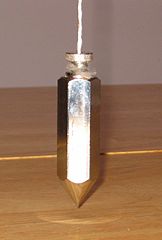
Plumb bob
Plumb bob from Wikipedia Commons
 The last part was Sunday morning worship at Camas Friends Church (a Quaker Meeting).  Peggy brought the message and a plumb bob.  Have you seen one before? It’s a heavy weight on the end of a string that helps to determine the vertical straight line that carpenters use to determine if a building is going up straight. It works because the weight always points to the center of the earth. She compared it to the Love of God, which can help us to orient our lives. The message was also about Truth and Compassion. And I didn’t take very good notes because it was an awe-inspiring message that captured my full attention. When I grow up, I want to know how to preach like Peggy. The Lord knows I will never be that good, but I am taking lessons starting now.

So now what? I know that the ministers who pulled this together are hoping that this Nursery of Truth idea might catch on. And if it did, I think that would be a good thing for the Religious Society of Friends/Friends Church. But how? Would it work to transport these ministers out of their local environment and invite them to speak at your meeting? Yes. Individually or as a group? Yes. Would it help to be conscious of how they went about attracting a not-the-usual-suspects crowd? Yes. Would it work to invite the ministers who are already in your local area to share their practical skills with Friends near you? Yes.

Would it be the same? No. I think that is the catch. God works in those mysterious ways, remember? Trying to replicate specific events or constellations of events becomes discouraging. We need to be open to how the Holy Spirit is leading us every time, all the time, and that is hard.

I think this is the lesson of Quaker open worship – it is different every time, but we need to keep coming back and experiencing the opportunity, even through dry spells, even when you know that people are going to talk about the latest political crisis (in our yearly meetings or in Congress), because we don’t know how or when the Holy Spirit will reach in and grab us by the scruff of the neck and take us to a new place.

Are you ready for that trip over Jordan? I don’t mean dying, I mean going to a strange land where we will have new responsibilities and new opportunities. This “new” land may look surprisingly like the neighborhood where you’ve been living all this time, or it may be thousands of miles away, but it will require new strength and courage to live there. And the basic skills of storytelling and relationship-building and a framework for understanding our place in the Divine story.

For these, I am grateful to the Nursery of Truth, and to Wess, Kathy, and Peggy for having the vision and the courage to bring us together.


All photos from Wess Daniels' Flickr set for Nursery of Truth unless otherwise noted. If you’d like to read more of the real-time commentary, search the Twitter stream for #nurserytruth.

1. Nursery of Truth was one of the names for the island of Barbados where many Quakers coming to the Americas in the 1600s stopped for rest and instruction before arriving in the northern English colonies. To read more, visit  Wess's blogpost.

2. Here is the list of attributes that were sought: Under 30 – AA – NA – LGBTQ – military service – never attended a cross-Quaker event – Work an hourly wage job – attend a Spanish language Friends Church – Rent your home – New Quaker – HS diploma or Associates degree as highest degree – Single parent – have ink or a bike that drinks fossil fuels…

Labels: , , , ,

Subscribe to Post Comments [Atom]

9.17.2012

Bivocational Ministry

So have you heard the term "bivocational ministry" before? If you have, there's a good chance that you've been to seminary, or known someone who did, or thought about going, or taught at one, some time in the last ten years. Or at least, I'm finding a strong correlation in the people I'm talking to.

So here's a short version of what I mean when I say "bivocational ministry":
God calls some people to work in ministry while also working either part or full time in secular jobs to supplement their income.  Bivocational ministry is when a person serves in a ministry while also being employed in a secular job, whether or not they get paid for their religious service. There is a growing conversation among those involved in the training and hiring of pastors, inside and outside the Religious Society of Friends/Friends Church (RSoF), about the need for bivocational ministry. Unprogrammed Friends have been talking more about preparing and supporting all the diverse ministers among us, but may be more familiar with the term “released Friend.”
Bivocational ministry was an essential part of the founding vision of Quakerism, when early Friends railed against the abuses of “hireling ministers.” Even where Friends have hired pastoral staff, we have sought to employ those who are called to the ministry by God, rather than relying on credentials or pedigree. We have acknowledged that a calling to a particular ministry may be for an undefined period of time, and yet not a permanent condition. Throughout our history, with variations depending on the region and the century, Friends have shared the burdens and the joys of ministry widely in our communities. As part of our uniquely Quaker spiritual inheritance, it’s a model that we can share with the world.

Bivocational ministry is quintessentially Quaker, but many meetings and churches are struggling today:
  • Many meetings can’t find enough volunteers to populate their elaborate committee structures. 
  • Even full-time pastors are not equally gifted in all areas of ministry assigned to them by the classic Protestant model. 
  • Many Friends have a calling to do more for their meeting or for the wider Friends Church, but can’t afford the loss of income. 
  • Many pastors are receiving the equivalent of part-time salaries yet expected to do full-time (plus your spouse) work. 
  • Friends from the programmed and unprogrammed traditions are going to seminary to prepare for service to the RSoF, often incurring substantial student debt, but there aren't enough paid jobs in Quakerism to absorb them all.
  • Many meetings and churches don't know what to do with strongly gifted Friends.
  • Friends feel both guilt-ridden and dismissive of their part-time pastors instead of celebrating this balance. 
This conversation touches on many difficult issues for Friends: money, leadership, theology, qualifications for ministry, membership numbers, culture and religious language, to name a few. It is related to a broader economic shift in the world around us, involving both changes in employment and ecological concerns around sustainability. Our society values and rewards single focus dedication, not a balanced life, no matter how many self-help books try to say the opposite.

Many yearly meetings have approached the training and support for bivocational ministers in various ways: weekend workshops, spiritual formation cohorts, pastors’ conferences, support for continuing education. Some local churches and meetings have developed innovative approaches to calling, supporting and releasing ministers. However, most of the best practices among Friends are not well known outside of their immediate geographic area or branch of Friends. The divided branches of the RSoF have a lot to offer one another in tackling the problems and celebrating the strengths of bivocational ministry. Their different perspectives complement each other.

As just one example, an unprogrammed meeting in an unaffiliated yearly meeting that I know had burned out two clerks of their Ministry and Oversight Committee in a row. Several contributing factors were identified, but both of the individuals in question said, “I don’t even want to come to worship on Sundays. It’s not like worship for me any more, it’s just a time when people come to tell me all their problems.” It occurred to a member of their M&O committee that this was a situation that people who are pastors deal with for their whole careers, not just a 1-3 year term on a committee. By inquiring with personal friends who were pastors in evangelical Friends churches, she heard some of their strategies for coping. One said his approach was two-fold. First was to accept that Sunday mornings were his time of service to the community, not his time of communion with the Holy Spirit. Sometimes that happened too, but changing his expectations helped him not to be annoyed when people just wanted to ask him, “where is the big coffee pot?” And second, he had to seek out other times for deep contemplation of the Divine, and he found that in a midweek gathering with other pastors for what was essentially unprogrammed Quaker worship. And so an evangelical Friend had learned from unprogrammed Friends, and a liberal Friend learned from an evangelical Friend. But too few of us know each other to be able to benefit from this learning.

How could Friends address this in a way that would be useful to the whole Religious Society of Friends/Friends Church? To the local meetings and churches that are struggling? For all the people who are struggling to find a way to use their gifts and live into their leadings?

How can meetings and churches have an honest and  conversation with each other and with the individual Friends who are called to serve the RSoF about how to make the best match between gifts and needs?

How can we amplify the work and learning that has already been done about calling, training and supporting ministry, by individual Friends and Quaker institutions, to benefit Friends more widely?

Frankly, I think the survival of the Religious Society of Friends/Friends Church in this century depends on us figuring this out better.

Full disclosure: I am, for the first time in my life, blessed and honored to be paid a full-time living wage for Quaker work. But I know, from 20 years of experience, what it is like for that not to be true. Also, this post reflects my personal leading and not that of my employer.

Labels: , , , , , , ,

Subscribe to Post Comments [Atom]

3.25.2012

Ageless Grace

Last weekend I attended a symposium called “Ageless Grace: Women in Leadership in the Church and in the World” at the Woodstock Theological Center at Georgetown University. There were two main presenters with two responders on stage, and then a period of questions and answers after each. The first presenter was Melanne Verveer, U.S. Ambassador at Large for Global Women’s Issues. The second was M. Cathleen Kaveny, Professor of Law and Theology at Notre Dame University. It reminded me of all the things I loved about my education at a Jesuit university. For Quakers and for Roman Catholics, on our best days, we share a fearless approach to knowledge as a reflection of God in the world.

What follows is not a description of what the speakers said. This blogpost began as I was asked to share my reflections and reactions at the end of the day, but then the event ran over time, for the best of reasons, and I didn’t get to speak, so I’ve tried to arrange my notes into something slightly more coherent. I may still edit this further for a longer article. As a Quaker, an alumna and a woman in church leadership, I was grateful for the opportunity to reflect on my practice with other women theologians.

Some of what I treasure most about Quaker tradition are the examples of my foremothers. Women who preached the Gospel and traveled far and hard in response to God’s leading.

Women many people have heard of, like Lucretia Coffin Mott and Elizabeth Fry. And like Mary Dyer, who was hanged on Boston Common for daring to preach her Quaker heresy in Massachusetts Bay Colony. Or Margaret Fell, the nursing mother of Quakerism, who wrote a tract in 1667 called “Women Speaking: Justified, Proved and Allowed of by the Scriptures, All such as speak by the Spirit and Power of the Lord Jesus and how Women were the first that Preached the Tidings of the Resurrection of Jesus and were sent by Christ’s own Command, before he ascended to the Father, John 20:17.” For more examples, I recommend the book, Daughters of the Light by Rebecca Larson.

These examples are a gift of Quaker history. It’s not that the Religious Society of Friends is or ever has been free of sexism but no one can point to our tradition and say that’s the way it’s supposed to be.

Inspiring examples of Quaker women are not all long ago and far away. It’s not only the province of extraordinary individuals whose example we could never live up to. They include women who are teaching alternatives to violence right now. Women who are pastoring and preparing to preach, right now.

Inspiring examples also include the women who spoke that afternoon. Women who are letting their lives preach as well as their words. Women who are advocating for truth and justice in their church and in the world.

Women my age and younger have so many examples before us. It’s getting a lot harder to be the first woman to do anything. On the other hand, we won’t have to be the first to do everything.

One benefit of the breadth and length of history is seeing multiple examples of how to be a woman in leadership in the church and the world. For me, it is deeply important that I can be a mother and a minister. But not everyone has to do it my way. God calls each of us by name, not by category.

Another gift of Quaker theology is our understanding of the role of the Holy Spirit - how God is speaking to all of us all the time. Our job is to listen, to try to understand with all our faculties, and to obey God’s leading. But fear gets in the way. I think fear is the single greatest obstacle to hearing and obeying when God calls us to change our minds, our practices, our society, our church institutions.

God’s guidance is more like a sacred compass than a GPS. Jesus gives us a steady point to steer by and gauge our progress, not step by step directions to our destination. (Thank you, Brent Bill, for the metaphor.) Two clichés that come to mind as appropriate for this discussion are “the bigger the ship, the longer it takes to turn it around” and “it’s always darkest before the dawn.”

I did get to have my little input after all. The last question that was read was mine. I asked, “Do you think that all the chaotic, painful events in the relationship of church and society these days are the death knell of religion or the birth pangs of a new role for the church/faith community in the world?”

And here’s my answer: Of course it’s both. A lot of old structures are dying, and some of them are thrashing around and shouting loudly on their way out. But because human beings have an innate capacity for and need for spirituality, new ways of being religious are being born. Those structures that “encourage flourishing,” as Cathleen Kaveny put it, will survive.

I pray for the strength and grace to follow God and lead Friends into ways that encourage flourishing.

Labels: , ,

Subscribe to Post Comments [Atom]

12.26.2011

Is It Dangerous to Let Teenagers Read Thomas Kelly?


On Sunday, there wasn’t a First Day School program at our Quaker meeting, so our boys were going to be with us all through meeting for worship. I pulled out the two little books that were in my purse and offered them to my 13 year old son: a very small print King James Bible or Thomas Kelly’s The Eternal Promise. He chose TEP and proceeded to actually read it. At that point it occurred to me to worry, “Am I going to regret this?”

Have you read any Thomas Kelly? (1893-1941) His more famous book is A Testament of Devotion. He writes about Quakerism and the religious life as if he was serious about it. Back in the late 1930’s he had some kind of mystical experience after a professional heartbreak in the middle of his career. Then he wrote several classic essays on religious experience: “The Blessed Community,” “The Gathered Meeting,” “The Simplification of Life,” “Have You Ever Seen A Miracle?”, and “Holy Obedience.”
"I have in mind something deeper than the simplification of our external programs, our absurdly crowded calendars of appointments through which so many pantingly and frantically gasp. These do become simplified in holy obedience, and the poise and peace we have been missing can really be found. But there is a deeper, an internal simplification of the whole of one's personality, stilled, tranquil, in childlike trust listening ever to Eternity's whisper, walking with a smile into the dark."
His lines about a life lived in accordance with a divine center, that takes no time, but yet all our time, are quoted in many Quaker books of Faith & Practice. If you are even a little bit religious, it is wildly inspiring to read Thomas Kelly’s words about the need and desire to give ourselves fully to God, to live a life of uncompromising devotion.

But teenagers don’t have enough knowledge or experience of life to know that Kelly can’t possibly mean it, that nobody really lives like that, that his kind of passion is excessive.

That made me ask myself how much I have let myself think that the world doesn’t really work that way, that nobody really lives like that, that he can’t really mean it.

And then I wondered how much trouble would I be in? How would I be held accountable for the life that I do lead if the young people in my life caught on to that thrilling vision?

Maybe we should encourage more young people to read Thomas Kelly.

Labels: , , ,

Subscribe to Post Comments [Atom]

2.23.2011

A New Mission for the Church?

Another post on Quaker Heritage Day 2011. For more, see my earlier posts. For my inspiration, all credit goes to God, C. Wess Daniels, and the awesome Friends who were part of the discussion.

Wess's first topic of the day (after his introduction) was a redefinition of the word mission. I feel like it was an opportunity to reclaim the word, much like Carol Spencer inspired me to reclaim the word holiness last year. He started by asking us what associations we had with the word and these ranged all over, from the saving of souls to military campaigns. I personally think of the haunting movie with Jeremy Irons & Robert DeNiro, The Mission.

As I see it now, the word "mission" for a postmodern church or meeting means something combining the secular nonprofit organizational meaning of a purpose for being, as in a mission statement, and the Quaker meaning of a leading, or a God-directed purpose. It means the work that a particular church or meeting is called to do and be, and Divinely fitted to do, and needed to do. I think it could be related to Walter Wink's concept of the angel of an institution, but I don't really feel qualified to address that connection.

So then Wess proposed a very interesting idea, that the mission of the church, broadly speaking, is to be a midwife to the spiritual life, of an individual or a community. Here are some of the interesting points that were generated:
(some come from Wess and some from the audience, they built on each other)
  • the midwife brings experience and training
  • the midwife trusts the mother to be competent
  • the midwife is not in charge or control of the labor
  • the midwife is not the baby or the impregnator of the mother, nor the one doing the labor, nor the one who will keep the baby
  • the midwife serves a particular area; she is mobile but not homeless
  • the midwife doesn't show up where she's not wanted or just on game day
  • the midwife is committed to the whole process, for better or worse, regardless of outcomes
Now substitute "minister" or "the church" for the "midwife" and read the list out loud to yourself.

The church trains and prepares and brings faith that a person or community can have, already has, a spiritual life. The church/minister has the role of accompanying the person who's developing their spiritual life - not in charge of creating it or saying where it will go, although they may have some experience of seeing how things often progress, and can be reassuring along the way. The church has to be flexible but not unmoored. A minister serves a community as a whole and people as individuals. The church has to be in it for the long haul.

I know I want to spend more time contemplating and discussing this image. Does it speak to you? Would your meeting or church be open to thinking about its purpose this way?

Labels: , , ,

Subscribe to Post Comments [Atom]

1.14.2011

Non-violent Street Smarts

Continuing my consideration of the spiritual needs of middle school students, I came to the juncture with the practical needs of middle school kids. One of the topics that I think has been seriously missing from my meeting’s religious education program is how to carry your faith out into the world. This could include issues like how to respond when someone asks you if you’ve been saved. Chuck Fager wrote a little book about that recently. But I live in San Francisco, and that’s really not a problem for the kids I know.

What is an issue here, and particularly for the young people that I know, is how to be safe in an urban environment that involves walking through neighborhoods that regularly have violence and other crimes on the street. Some of our families live in neighborhoods like that; some kids go to school in neighborhoods like that; our meetinghouse is located in a neighborhood like that. So it’s not just an abstract idea or an occasional need, it’s a day to day concern.

I was further inspired by the article in this month’s Friends Journal about teaching peace in a culture of violence and by George Lakey’s article in last month’s Western Friend where he tells about using techniques he learned from John Wesley about getting out of a dangerous situation.

I personally grew up in a small town in a very rural area. There was violence, but it was more likely to be between family members and friends than from strangers. This is still true in the big city, but the likelihood that you’ll have to pass through someone else’s personal drama on the sidewalk or on the bus is higher in the city. And I think the chance of random robbery is higher here. Definitely, the open sale of drugs and prostitution is higher here than in my home town.

Anyway, my point is that I didn’t learn very much about how to be safe in the city from my family. I was given explicit instructions by a co-worker in New York City when I was 24 years old. We were working with kids in very poor neighborhoods, and as we visited their homes, my co-worker taught me a lot about being aware of other people, how to conduct myself to not look like a target, and how and when to avoid trouble. But now I live in a city where my kids need to learn this stuff by age 12, not 24. And I’m not really sure how to teach it.

The self-defense classes I hear about for young people are mostly run by martial arts schools. And I know that a lot of the curriculum in these places is how to avoid having to use violence. But I’d really like my kids to get that part followed by some non-violent conflict defusing techniques and then what to do after violence happens to you or around you. I think this could be an ideal topic for a yearly meeting middle school program where we’d have a critical mass of kids.

I know that there are Quakers with enormous experience in conflict resolution. I know Friends who have personally faced angry mobs, who have taught non-violent resistance around the world, and who are highly skilled in defusing dangerous situations. But as far as I can tell, they’re not teaching our young people how to do the same. At least, not here in SF.

So I have started asking the people I know for help. One Friend, who is an expert in early childhood education, but also has experience working with older kids, recommended a book called The Gift of Fear by Gavin de Becker. It’s mostly encouraging people to trust their intuition about other people and situations. Another friend, who is very wise in the ways of adolescents and an experienced urban educator, said that the best defense is confidence – not making kids afraid of their environment, and she cautioned me about the developmental capacity of 11 and 12 year olds to use any strategies, however valuable, to resist predators. Her concern was to not make kids feel guilty for being victims.

So my current thinking is that a workshop would cover five topics:

• Be aware
• Avoid trouble
• Defuse conflict
• Help others at risk
• Get help when violence happens

Some of it would be basic things like how to carry your valuables, where to sit on the bus, and planning your route.

Some of it would be learning to pay attention to who else is around you and what they are doing, how and when to mind your own business, evaluating your risks, and going around a visible trouble spot.

Some of it would be what to do when trouble happens to you – thinking about who you could ask for help in different places, how to reduce the chances of getting hurt, who do you tell afterwards.

The trickiest part is to know how and when you can help someone else, when you are a bystander. Obviously, this part changes dramatically depending on the environment, the other people involved, and your own physical and emotional capabilities. (Just as an example, I might expect more if a 12 year old sees another kid picking on a kindergartener at school than if she sees a grown-up getting robbed at the back of the bus.)

And I’d like this to all be done in a spirit of love and trust and compassion. With the assumption that there is that of God in every person and that we can speak to that spark of goodness. And the full knowledge that not every one will act with that goodness.

I don’t want to teach my children how to fight back with their fists. (I’d be no help with that either.) But it’s not enough to just say “turn the other cheek” without giving some practical suggestions for when nonresistence is unproductive.

Do you have any experience with this kind of work? What do you think would be the most important things for Quaker kids to learn? If you know of specific people or meetings who are already doing this well, please leave a comment or email me directly. Thanks!

Labels: , , ,

Subscribe to Post Comments [Atom]

12.22.2010

Reading Suggestions for 13 Year Old Quakers?

As I wrote about in my last post, my Meeting is looking at alternative forms of religious education for our young teen Friends. One possibility is to provide a suggested reading list that these Friends could bring with them to meeting for worship.

I think it's really good for teens to be in worship with the adult community. I think that the only way to really learn about Quakerism is to practice it. I also think that teens often lead very busy and full lives and an hour of quiet reflection and prayer can be as helpful to them as to any adult. But I also know, from my own experience, that sometimes it feels like a long time if you're not really in the mood. And at least my kids don't really have a choice about coming or not.

So I'd like to offer some suggestions for things to read in meeting to help with spiritual formation and centering. Ideally, they wouldn't just read all through worship, but if something caught their attention, I wouldn't stop them. However, the latest Percy Jackson novel is not going to make my short list for reading in worship, even if it does touch on questions of divine intervention. So I've started asking Friends in my Meeting for suggestions of books or other reading material that was significant to them when they were teenagers or that they think might be helpful or attractive to young Friends today. Here's what I've got so far:
  • Friend by Jane Yolen
  • Friends Journal and other Quaker magazines
  • The Message translation of the Bible
  • Spirit Rising: Young Quaker Voices, edited by Angelina Conti, et al
  • Whispers of Faith: Young Friends Share Their Experience of Quakerism edited by Geoffrey Black, Zion Klos, Claire Reddy, Milam Smith, Rachel Stacy
  • Run Baby Run by Nicky Cruz
  • The Cross and the Switchblade by David Wilkerson
  • Towards a Quaker View of Sex by a few Friends in Britain (one of whom is now a member of my Meeting), published by Friends Home Service in 1964
  • Pendle Hill Pamphlets
I haven't read all of these so don't take them as a recommendation from me, just a collected list. If you have any opinions about these options, leave a comment. If you have additional suggestions, please leave a comment. If you could ask teens that you know to add some suggestions, that would be awesome!

Labels: , , ,

Subscribe to Post Comments [Atom]

12.19.2010

Middle School Affirmations

Over the last four months, I've been coordinating a middle school religious education program at my Meeting. We have three boys in 6th & 7th grades (one is my son) who make up the class, and three teachers who were willing to take turns preparing & leading the lessons. It’s been a delight for me.

A few months ago, I wrote about what I want our kids to get out of First Day School. I really think we made progress this fall. At the end of August, all six of us met to set goals, discuss our expectations, and suggest ways to make the program work for all of us.
Here is the list of what the adults want for kids in FDS:
  • To know what Quakers do
  • To know about the Bible
  • To know what you believe
  • To know some Quaker history
  • To make friends
  • To develop good, strong values
  • To want to come to FDS
  • To feel part of the meeting community
Here is the list of what the kids want out of FDS:
  • Good snacks
  • To want to/to be excited to come
  • To be able to read what you want
  • To know who/where God is
  • Fun stuff – games, clay, trust games
  • Be more active
  • Drawing
  • Make things for meeting
If you look closely, there’s some overlap in those lists, but at the very least they are not mutually exclusive. You can have good snacks and learn Quaker history in one day, trust me.

We had a monthly service project, serving brunch at the Martin de Porres Hospitality House on the fourth Sunday of each month.

On the day of SF Meeting’s fifth Sunday Extended Meeting for Worship, we held a Meeting for Worship with a Concern for Bicycling. We rode along the Bay Trail and stopped for worship near Coyote Point. It was a gorgeous day and just being outside felt holy to me. One highlight was the brief discussion afterwards where we talked about why riding our bikes felt more worshipful than being on one of the loud electric scooters that went by us.

We had a section on George Fox. Starting during worship-on-the-grounds at the Hardly Strictly Bluegrass Festival, we read Friend by Jane Yolen. The next couple of weeks we talked about the origins of Quakerism, the role of Quaker journals, and the spread of Quakerism through the world – all tangents that rose up out of our discussion of Fox. And one week we unpacked the George Fox Song and talked about what each line means and why each section is an important truth about Quakerism.

We had another section on what to do in meeting for worship. One week we discussed the effects of meditation on the brain. One week we learned about Lectio Divina as another way of looking at reading in meeting. That week we also had visitors from the 6th & 7th grade class at the local Unitarian Church, and we talked about the differences and similarities of our two groups.

We had a series of discussions about current events – the flap over “the mosque at Ground Zero” was big right when we were starting, so we talked about religious persecution and tolerance, and one of our teachers went to Jordan for a Habitat for Humanity build during this fall and she talked about her trip, and then last week they wrote letters to the President about the war in Afghanistan.

This morning we held an evaluation session. We looked at which of our goals we had achieved and how we might improve the curriculum for another time. The kids said you really couldn’t make it better without it just becoming like camp where you don't learn anything. But they would like to do more trust games and to learn more about modern Quakers. They would like to read something about Quakers that was written by someone who didn’t like the Quakers – what would they say about Quakers? (I think this would be very interesting – if you know of anything like this that’s readily accessible, let me know.)

The thing they liked best was the snacks. It is my personal opinion that middle school religious education is already overcoming enough barriers – a spoonful of sugar helps the medicine go down. These particular kids eat very healthy diets the rest of the week.

However, today was the last day of our group because two thirds of the kids and one of the teachers are moving to South Africa next month. Hence today’s evaluation. We also wrote affirmations for all the members of our group. Here are the affirmations I received:
  • Thank you for being willing to teach so we don’t need to go to meeting.
  • Thank you for always having a enjoyable lesson planned.
  • Thank you for teaching and the donuts.
I really appreciated the honesty and curiosity and imagination that these boys brought to our time together. I will really miss the class. In the future, the one kid who is staying has chosen to go to meeting for worship every week rather than join the little kids or have a separate class all by himself. I support that decision and we’re looking at other ways of continuing his religious education.

Labels: , ,

Subscribe to Post Comments [Atom]